The Byzantine Empire: Justinian’s Reign, Legal Revolution, and Church Divide
This chapter explores the reign of Justinian I, highlighting his attempts to restore the power of the Roman Empire and the compilation of the Justinian Code, a cornerstone of Byzantine law that influenced European legal systems. It details his reign's expansion, his counsel with Empress Theodora and General Belisarius, and the socio-religious upheavals, including the iconoclast controversy leading to the split between the Roman Catholic and Eastern Orthodox Churches. Ultimately, the chapter discusses the empire's decline post-Justinian due to internal strife and external invasions.
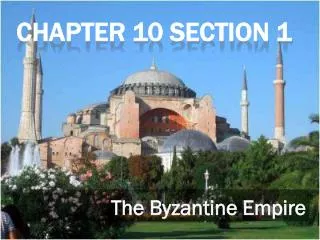

The Byzantine Empire: Justinian’s Reign, Legal Revolution, and Church Divide
E N D
Presentation Transcript
The Byzantine Empire Chapter 10 Section 1
Justinian: attempted to revive power of Roman Empire • Justinian Code: collection of Roman law into four parts • Basis of Byzantine law; established legal framework of future European systems • Advised by his wife Theodora and general of the army, Belisarius • Ex. Status of women, Nika Revolt • Empire grew to its largest under Justinian Growth of the Byzantine Empire
Strong central government with emperor and efficient and skilled gov’t officials Create alliances through marriage w/ foreign powers Strong army and navy; chemical weapons “Greek Fire” Constantinople; wealthy capital, strategic location to control sea trade between Asia and Europe Imperial taxes raised huge revenues Strengths of Empire
Differences in church practices led to split in the church of the West and East Patriarch of Constantinople- most powerful church leader in East Icons- holy picture of Jesus, Virgin Mary, or saints Iconoclasts- icons in church is like worshipping idols; believe that is wrong Christian Church
787 A.D.- Pope calls a council to allow icons in church • Those who refuse (iconoclasts) are heretics and excommunicated • Heresy- opinion conflicts with church teachings • Excommunication- no longer a member of the church • Led to the split between the Roman Catholic and Eastern Orthodox Church in 1054 Iconoclastic controversy
Roman Catholic Eastern Orthodox • Priests forbade to marry • Accept icons • Pope; supreme authority of church • Accepted that the Holy Spirit combines with both Father and Son in Trinity • Priests allowed to marry • Initially rejected, later accepted icons • Reject supremacy of Roman pope • Maintained supremacy of the Father in the Trinity Major Disagreements
After Justinian’s death in A.D. 565, they had many wars • Many groups began to take land away from the empire • Ex. Muslim Empire in Middle East & Africa • Western Europe defends Byzantine 1096-1099 (1st Crusade), then seizes capital in 1204 (4th Crusade) • Ottoman Turks took Adrianople, then Constantinople in 1453 • Byzantine Empire collapsed Decline of the Empire