Optimizing Sensor Information for Enhanced Deceptive Detection Strategies
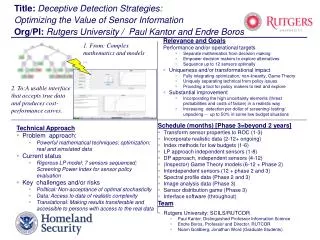
This research focuses on developing effective strategies for optimizing sensor information to enhance the value of detection systems against deceptive threats. Conducted by Rutgers University scholars Paul Kantor and Endre Boros, the study employs advanced mathematical techniques, including optimization and game theory, to separate technical and policy issues, enabling decision makers to explore alternatives. The project aims to improve detection efficacy and cost-performance ratios significantly, even in low-budget scenarios, by integrating complex data with user-friendly interfaces and innovative models.

Optimizing Sensor Information for Enhanced Deceptive Detection Strategies
E N D
Presentation Transcript
Title:Deceptive Detection Strategies: Optimizing the Value of Sensor Information Org/PI:Rutgers University / Paul Kantor and Endre Boros Relevance and Goals Performance and/or operational targets • Separate mathematics from decision making • Empower decision makers to explore alternatives • Sequence up to 12 sensors optimally • Uniqueness and/or transformational impact • Fully integrating optimization, non-linearity, Game Theory • Uniquely separating technical from policy issues • Providing a tool for policy makers to test and explore • Substantial improvement • Incorporating the high uncertainty elements (threat probabilities and costs of failure) in a realistic way • Increasing detection per dollar of screening/ testing/ unpacking -- up to 50% in some low budget situations 1. From: Complex mathematics and models ... 2. To:A usable interface that accepts true data and produces cost-performance curves. Schedule (months) [Phase 3=beyond 2 years] • Transform sensor properties to ROC (1-3) • Incorporate realistic data (2-12+ ongoing) • Index methods for low budgets (1-6) • LP approach independent sensors (1-8) • DP approach, independent sensors (4-12) • (Inspector) Game Theory models (6-12 + Phase 2) • Interdependent sensors (12 + phase 2 and 3) • Spectral profile data (Phase 2 and 3) • Image analysis data (Phase 3) • Sensor distribution game (Phase 3) • Interface software (throughout) Team • Rutgers University: SCILS/RUTCOR • Paul Kantor, Distinguished Professor Information Science • Endre Boros, Professor and Director, RUTCOR • Noam Goldberg; Jonathan Word (Graduate Students) Technical Approach • Problem approach: • Powerful mathematical techniques; optimization; real and simulated data • Current status • Rigorous LP model; 7 sensors sequenced; Screening Power Index for sensor policy evaluation • Key challenges and/or risks • Political: Non-acceptance of optimal stochasticity • Data: Access to data of realistic complexity • Translational: Making results transferable and accessible to persons with access to the real data