Balancing Chemical Equations: Understanding Reactants, Products, and Coefficients
110 likes | 234 Vues
This guide covers the fundamentals of balancing chemical equations, crucial for understanding chemical reactions. Learn how to balance skeleton equations and word equations effectively. Key concepts include identifying reactants and products, and utilizing coefficients to ensure adherence to the Law of Conservation of Matter. We provide examples with diatomic elements and explore how to interpret both skeleton and word equations. Mastering these basics is essential for deepening your knowledge of chemistry and preparing for more complex reactions.


Balancing Chemical Equations: Understanding Reactants, Products, and Coefficients
E N D
Presentation Transcript
Balancing Chemical Equations Section 10.1
Objectives • Balance skeleton equations • Balance word equations
Key Terms • Chemical reaction • Reactants • Products • Coefficient • Chemical equation
Review (VERY IMPORTANT!) • What are the diatomic elements?
Review (VERY IMPORTANT!!) • How many atoms of each element are in the following: • HCl • Na2S • Ca3P2 • Mg(NO3)2
Chemical Equations • Represents a chemical reaction • Uses an arrow to separate reactants from products • Reactants • Starting substances • Left side • Products • Ending substances • Right side
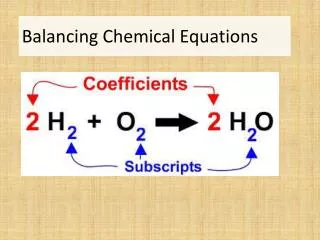
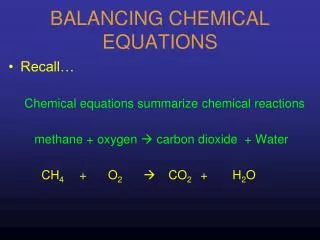
2 Types of Equations • Skeleton • Gives formulas • H2 + O2 H2O • Word • Gives names • Hydrogen and oxygen react to form water
Balancing • Chemical equations MUST be BALANCED • Law of Conservation of Matter • Number of atoms of each element must be equal on both sides of arrow • Only COEFFICIENTS can be used
Coefficients • Number in front of a formula • How many atoms of each element are there in the following: • 2HCl • 4Na2S • 3Ca3P2 • 2Mg(NO3)2
Skeleton Examples • H2 + Cl2 HCl • CO + O2 CO2 • KClO3 KCl + O2
Word Examples • Iron (III) chloride reacts with sodium hydroxide to form iron (III) hydroxide and sodium chloride • Carbon disulfide reacts with oxygen, producing carbon dioxide and sulfur dioxide • Zinc and sulfuric acid react to form hydrogen and zinc sulfate