Understanding Price Elasticity of Demand and Income Elasticity Formulas
Learn how to calculate arc price elasticity for demand curve D, practice with various scenarios, and understand income elasticity of demand using different formulas and concepts.


Understanding Price Elasticity of Demand and Income Elasticity Formulas
E N D
Presentation Transcript
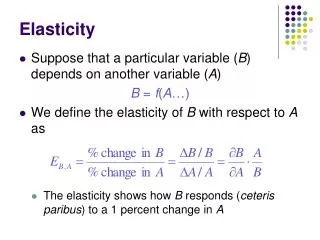
Calculating the Arc Elasticity If Ed > 1, demand is said to be “price elastic”. If Ed < 1, demand is said to be “price inelastic”.
% of Qd d = % of P Arc price elasticity for demand Curve D: The price decreases from $10 to $8 First, start with the top of the formula % of Qd (which means) (90 – 80) = 10 = (0.117) .12 (90 + 80)/2 = 85 .12 Second, figure out the bottom formula % of P (which means) Now Divide = (0.545) .22 (10 – 8) = 2 = (0.222) .22 (10 + 8)/2 = 9
% of Qd d = % of P Arc price elasticity for demand Curve D1: The price decreases from $10 to $8 (110 – 80) = 30 = 0.32 (110 + 80)/2 = 95 .32 Now Divide = 1.45 .22 (10 – 8) = 2 = 0.22 (10 + 8)/2 = 9
Practice! % of Qd d = % of P • What is the arc elasticity from P = 9 to P =8? (1 – 2) = |-1| = 1 = 0.67 (1 + 2)/2 = 1.5 0.67 = 5.58 0.12 (9 – 8) = 1 = 0.12 (9 + 8)/2 = 8.5
Income of Elasticity of Demand % of Qd d = • If εI > 1, the good is normal and income elastic (a luxury). • If 1 > εI > 0, the good is normal but income inelastic (a necessity). • If εI < 0, the good is inferior. % of I
So, now you know how to use the formula. • Apply the same concept to these other formulas.