
Understanding Compiler Design: Parsing, Derivations, and Code Generation
E N D
Presentation Transcript
Machine Code Program Add v,v,0 cmp v,5 jmplt ELSE THEN: add x, 12,v ELSE: WHILE: cmp x,3 ... v = 5; if (v>5) x = 12 + v; while (x !=3) { x = x - 3; v = 10; } ...... Compiler
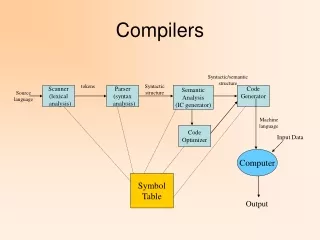
Compiler Lexical analyzer parser input output machine code program
A parser knows the grammar of the programming language
Parser PROGRAM STMT_LIST STMT_LIST STMT; STMT_LIST | STMT; STMT EXPR | IF_STMT | WHILE_STMT | { STMT_LIST } EXPR EXPR + EXPR | EXPR - EXPR | ID IF_STMT if (EXPR) then STMT | if (EXPR) then STMT else STMT WHILE_STMT while (EXPR) do STMT
The parser finds the derivation of a particular input derivation Parser input E => E + E => E + E * E => 10 + E*E => 10 + 2 * E => 10 + 2 * 5 E -> E + E | E * E | INT 10 + 2 * 5
derivation tree derivation E E => E + E => E + E * E => 10 + E*E => 10 + 2 * E => 10 + 2 * 5 + E E 10 E E * 2 5
derivation tree E machine code + E E mult a, 2, 5 add b, 10, a 10 E E * 2 5
Parser input string derivation grammar
Example: Parser derivation input ?
Exhaustive Search Phase 1: Find derivation of All possible derivations of length 1
Phase 2 Phase 1
Phase 2 Phase 3
Final result of exhaustive search (top-down parsing) Parser input derivation
Time complexity of exhaustive search Suppose there are no productions of the form Number of phases for string :
For grammar with rules Time for phase 1: possible derivations
Time for phase 2: possible derivations
Time for phase : possible derivations
Total time needed for string : phase 1 phase 2|w| phase 2 Extremely bad!!!
There exist faster algorithms for specialized grammars S-grammar: symbol string of variables appears once Pair
S-grammar example: Each string has a unique derivation
For S-grammars: In the exhaustive search parsing there is only one choice in each phase Time for a phase: Total time for parsing string :
For general context-free grammars: There exists a parsing algorithm that parses a string in time
A Substitution Rule Equivalent grammar SubstituteB
In general: Substitute B equivalent grammar
Useless Production Some derivations never terminate... Useless Productions
Useless Production Another grammar: Not reachable from S
In general: If Then variable is useful Otherwise, variable is useless
A production is useful if all its variables are useful
Removing Useless Productions Example Grammar:
First: find all variables that produce strings with only terminals Round 1: Round 2:
Keep only the variables that produce terminal symbols
Second: Find all variables reachable from Dependency Graph not reachable
Keep only the variables reachable from S Final Grammar
Nullable Variables Nullable Variable:
Removing Nullable Variables Example Grammar: Nullable variable
Final Grammar Substitute
Unit-Productions Unit Production:
Removing Unit Productions Observation: Is removed immediately
Remove repeated productions Final grammar
Removing All • Step 1: Remove Nullable Variables • Step 2: Remove Unit-Productions • Step 3: Remove Useless Variables