Download
1 / 25
250 likes | 368 Vues
This project showcases the collaborative efforts of a talented team of engineers in developing JOE-BOT, an innovative robot designed for autonomous fire extinguishing. The robot features advanced movement capabilities with multi-directional wheels and sophisticated sensor navigation systems. It addresses various challenges, including ramp navigation and obstacle detection. The report details the design process, including the selection of components, modifications to the chassis, and rigorous testing of the robot’s functionality to ensure efficient operation in emergency scenarios.

E N D
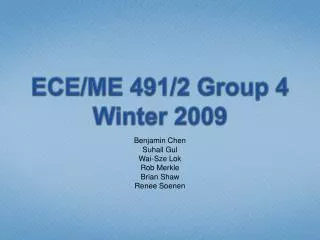
ECE/ME 491/2 Group 4Winter 2009 Benjamin Chen SuhailGul Wai-SzeLok Rob Merkle Brian Shaw Renee Soenen
Meet the All-Star Team! Benjamin ChenElectrical Engineer SuhailGulElectrical Engineer Brian ShawComputer Engineer Wai-SzeLokMechanical Engineer Renee Soenen Mechanical Engineer Rob MerkleMechanical Engineer
Meet JOE-BOT! JOE-BOT IS COMING FOR US! RAWRR!
DC Motor vs Modified Servo • DC Motor: • Energy efficient • Powerful • Modified Servo: • Excellent control of speed • Sufficient torque and speed in a compact unit • Internally geared • Don’t need H-bridges
Digital Servo • Problem: • Kept rotating slowly with no pulse input • Possible Reason: • Internal mechanical issue • Servos and board may not compatible
DC Motor Problem: • Exceeded size • Less space • Solution: • Modified original chassis by machining notches • Flip the chassis, so the motors were on the underside
Design Changed • Machining notches into the sides • Flip chassis provide more space • 3 platforms instead of 2
Video of 90° turn MOVEMENT Multi – directional wheel called a Transwheel Two motors drive the set of wheels that are 180° apart 90° degree turns switching power to other set of wheels Provides versatility of movement with no steering
Video of 45° approach across ramp MOVEMENT ISSUES Driving wheels lift off the ground at bottom of ramps Resolve by driving up the ramp at 45° New FEA due to different torque on the motor shaft
Y FINITE ELEMENT ANALYSIS X N Ff 15° 10.545° ∑Fx = 0 = Ff-Wx Free Body Diagram – 3 Dimensional Torque ∑Fy = 0 = N-Wy ∑M = 0 = Ff*r - T Wx Wy Wsin(10.545°)*r=Wx*r=T W
FEA - MODEL Custom Shaft Assembly W T Nylon Adapter Motor Shaft “Universal” Hub
Fire Extinguisher • Pump • Reservoir • Check-valve • Nozzle
Fire Extinguisher • Operating at 12 volts • 0.54 GPM • Mounted at 20 cm • Turned on with a relay switch
Fire Extinguisher • VIDEO OF ROBOT EXTINGUISHING FLAME
Cost Analysis Material Costs Labor Costs
Electronic Platform Selection • Motorola HCS12 based EVBplusMiniDragon+ • Easiest to program for (familiarity) • Enough I/O connectivity • Low enough overall power usage
Stages of development on the design • Type of Platform and wheel vs. track • Use of servos vs. motors • Different types of sensors proposed to be used • Navigational Algorithm.
Parts and Components • Servo mountings and turrets holder • 360⁰ Turret • Aluminum base shaping and cutting and supports • Mounts for motors. • Motor Gears.
Circuits and Wiring • H Bridge. • Voltage Regulator.
Circuits and Wiring • Pump Switch Circuit. • Wiring for Power Sources and sensors
Testing and Interfacing the Sensors • Programming servos and setbacks. • Motor Control . • Sensors Testing. • Digital IR Sensors. • Analog IR Sensor. • Compass Module. • TPA 81. • Sonar.
Basic Movement • 4 Omni-Wheels, two wheels each side of the robot. • Each wheel can be turned independently of the others. • The capability of independent wheel control combined with the placement of the wheels allows for versatile movement controls. • Very fast zero-radius turning. • Vectored movements, e.g. sideways and 45° diagonal movement. Navigation
Navigation Ramps • Ramps have posed a formidable challenge for Joe-bot. Due to the wheel placements, it cannot drive straight onto a ramp. This is both a curse and a blessing. • It is possible for Joe-bot to detect a ramp simply by checking the long distance rangefinder. If it has detected that it has not moved and the distance is more than a few centimeters, then it is in front of a ramp. • The Joe-bot can then turn 45° and travel at that angle to get on the ramp and over it. Obstacles • Obstacles in the rooms are still a challenge. The sensor array as it stands has a tough time discovering obstacles.
Navigation Hallway Travel • Joe-bot has three pairs of short range IR sensors on the front and sides. Also, it has a long range sonar rangefinder. • It can currently navigate the hallway by keeping track of whether or not walls are sensed on either side by the IRs and also using the rangefinder. Room Mode • When we approach a room, Room Mode becomes active. This is a special procedure for detecting the candle, putting it out and exiting the room we entered. • The room is scanned either once or twice; if we detect extra heat (the candle), the second sweep searches for obstacles. • We then move toward the candle and extinguish it.