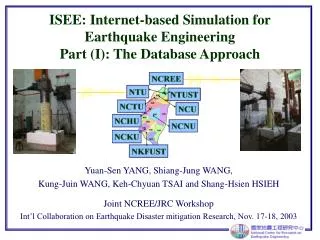
Networked Structural Experiment Protocol for Earthquake Disaster Mitigation
110 likes | 220 Vues
In the framework of the NCREE/JRC Workshop on Earthquake Disaster Mitigation Research, this documentation outlines the Platform for Networked Structural Experiments (PNSE) and the Networked Structural Experiment Protocol (NSEP). The report covers key aspects such as experimental validation, efficient data transmission, and the handling of diverse facility controls. It discusses the implementation of networked pseudo-dynamic tests conducted on a 3-story CFT/BRB frame, highlighting the benefits of collaborative experimentation across different geographical locations, specifically Taiwan and Stanford.


Networked Structural Experiment Protocol for Earthquake Disaster Mitigation
E N D
Presentation Transcript
ISEE Part IIThe Application Protocol Approach K.J. Wang, S.J. Wang, W.C. Cheng, Y.S. Yang, K.C. Tsai National Center for Research on Earthquake Engineering Joint NCREE/JRC Workshop International Collaboration on Earthquake Disaster Mitigation Research October 18, 2003
Outline • Demands • Platform for Networked Structural Experiments (PNSE) • Networked Structural Experiment Protocol (NSEP) • Experimental Validation • Networked Pseudo Dynamic Tests on 3-story CFT/BRB Frame • Conclusions
Demands • Environment independent - Different facility controllers, control programs, OS, computer hardware • Event reflective - Change of running state: READY, RUNNING, HOLDING, INTERRUPTED_TEMP, INTERRUPTED, FINISHED - Lab events:specimen adjustment, control problems, … etc. (worthy recorded) - Human conversation (not worthy recorded) • Efficient transmission • Data security • Friendly individual participation
PNSE(Platform for Networked Structural Experiments) PNSE Server CGM DB server Web server Viewer Camera Video server FCM #1 FCM #2 NSEP data packets based on TCP/IP CGM: Command Generation Module FCM: Facility Control Module commands responses
Length Type Data 2 bytes 1 byte n bytes NSEP(Networked Structural Experiment Protocol) Packet composition • SD_ERROR • SD_LOGIN • SD_PRJINFO • SD_SIGNALINFO • SD_PRJSTATE • SD_CLNSTATE • SD_CPSCMD • SD_IDVCMD • SD_IDVRSP • SD_CPSRSP • SD_SIGNAL • SD_DISCUSS packet packet Server Client • Command cycle - SD_CPSCMD, SD_IDVCMD - SD_IDVRSP, SD_CPSRSP - SD_SIGNAL • Active notification (Event trigger) - To save networked resources - To enhance overall efficiency - To accommodate more complex interactions in the future
6.0 m concrete infilled C1 C2 2.37 m Y Y X X double tube F NTU Lab NCREE Lab C S F F C S F C S F F Experimental Validation • 3 Tests - Test A: Domestic - Test B: Transnational (CGM at Stanford) - Test C: Transnational (Server at Stanford) • Test results: displacement histories A (TW) B (US) (TW) C (US) (TW)
F F C S F C S F Internet (CGM ⇔ Server) Internet (FCM ⇔Server) Server works CGM works FCM works (actuator control) FCM works (miscellaneous) C S F F Experimental Validation (cont.) Test A (domestic) Test B (CGM Stanford) Test C (server Stanford)
Experimental Validation (cont.) • Time consumed in data transferring over the Internet is quite stable
PDT on 3-story CFT/BRB Frame FCM, Windows XP Web guest PNSE server, Windows XP Web guest Database server MS SQL Server Windows 2003 Web server Windows 2003 CGM, FreeBSD Web guest
Conclusions • All data including command and lab feedback can be transmitted correctly on PNSE. • Efficiency of PNSE is satisfactory. Less than 0.1701 seconds is needed for a packet to make a round trip between Taiwan and Stanford. • Running states of the whole project and of all PNSE clients can be reflected accurately and promptly on PNSE. • The proposed PNSE and NSEP has preliminarily achieved the goal of networked collaborative experiments.
Scan Scan Write to Database Actuator control Get scanned data (i=0) Send force to server Get scan data (i=1) Sleep Sleep Send force to server Send scanned data to server (i=0) Ramp Trigger (i=2) Send scanned data to server (i=1) Trigger (i=1) Send initial condition to FCM Send calculated responses to FCM Send calculated responses to FCM PDT on 3-story CFT/BRB Frame