Download
1 / 6
70 likes | 203 Vues
Molar mass refers to the mass of one mole of an element or compound, crucial in chemistry for quantifying the amount of substance. This guide explains how to calculate the molar mass of compounds, such as calcium phosphate (Ca3(PO4)2), by summing the masses of individual atoms found on the periodic table. Additionally, it covers how to find the percentage composition of each element within a compound, including cobalt (II) phosphate. This resource is essential for students and anyone looking to deepen their understanding of chemical measurements.

E N D
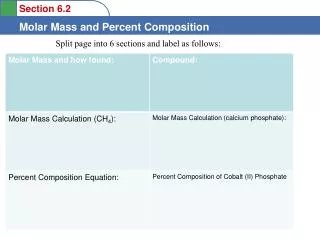
What is molar Mass? • Molar Mass: the mass of one mole of an element or compound; a mole is a unit of measurement in chemistry used to tell the amount of something • Compound? • The molar mass of a compound is obtained by summing the masses of the component atoms. (the mass of each atom is the decimal number found on the periodic table)
Calculate the Molar Mass of the following: • Calcium Phosphate: • What is calcium phosphate’s formula? • Ca3(PO4)2 • How many of each element are in the compound and what are the masses of each element? Ca: 3 * 40.078 = 120.234 P: 2 * 30.9738 = 61.9476 O: 8 * 15.9994 = 127.9952 TOTAL: = 310.1768 g/mol When you are asked to show your work when finding the molar mass, the above is what I need to see!
% Composition how much of each compound is made up of a particular element 5 mass of element mass of compound % element = x 100
Calculate the % composition of each element in cobalt (II) phosphate Formula: ________________ % Co: __________ Molar Mass: ______________ % P: ___________ % O: ___________ Mass of Co: ____________ Mass of P: _____________ Mass of O: _____________