Download
1 / 17
170 likes | 323 Vues
The Atacama Cosmology Telescope (ACT), based in the Chilean Atacama Desert, aims to create detailed maps of cosmic microwave background (CMB) anisotropy at unprecedented scales. With goals to study the primary CMB power spectrum and survey for Sunyaev-Zel'dovich (S-Z) clusters, ACT explores dark energy, structure formation, and inflation. Utilizing advanced techniques like a unique scan strategy and cutting-edge bolometer technology, it complements ongoing efforts from institutions such as Princeton, Columbia, and NASA. The telescope's innovative design promises to enhance our understanding of the universe.

E N D
The Atacama Cosmology Telescope New Views of the Universe Joe Fowler Princeton University December 11, 2005
ACT: The Big Idea • Goal: mapℓ>1000 CMB anisotropyin 3 colors (1-2 mm) • Study the primary CMB power spectrum • Survey for S-Z clusters • Follow clusters in optical & X-ray • Address Dark Energy in the “recent” universe, structure formation, inflation…
Columbia U Mass Princeton Penn Toronto Católica CUNY Haverford ACT Institutions
Current CMB Power Spectrum Next big question: ns scalar spectral index. It comes from the overall slope of the power spectrum. Small-angular scale measurements are essential.
Signature in a Blind SZ Survey 145 GHz decrement 220 GHz null 270 GHz increment 1.4°x 1.4°
CMB after WMAP: Arcminute mm Surveys 150 GHz 1.4° (~2% of high quality area) MBAC on ACT 1.7’ beam w/ noise SZ Simulation PLANCK
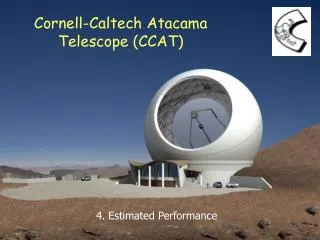
Atacama Cosmology Telescope 6 meter primary Entire telescope scans in az Preliminary designs by AMEC
Telescope under construction AMEC Dynamic Structures near Vancouver, B.C.
Making CMB Maps • Scan strategy: constant elevation • Aim: deep 100-200 deg2 map • Atmospheric gradient of 65 mK across field 2° full range
Cross-Linked Scans Each spot observed in 2 distinct stripes: before and after meridian crossing (green, red) Dec R.A.
Chilean Atacama Desert Cerro Toco site: >5000 meters
1.2° square on sky Cold Reimaging Optics (n=3.41) 6m + 2m mirrors Map of Strehl ratio: black=diffraction-limited; red=95%
TES Pop-up Bolometers 3.5 cm 1x32 TES Chip (unfolded) TES Shunt Resistors + Nyquist Inductor SQUID Multiplexer Aluminum on Silicon Circuit Pop-up geometry permits close packing in focal plane.
Bolometer Array Camera • 145, 220, 270 GHz • Each a 32x32 array • Close-packed • Free space coupling • Mo-Au TES detectors • Developed by GSFC and NIST
ACT Progress • Engineering units being studied now • Sky testing with prototype camera began this autumn • Field ACT in 2006, full camera ≤3 years WMAP optical mockup
Saturn Unauthorized! Saturn observed 4 days ago at 2mm wavelength with TES + SQUID MUX camera. Map=8 minutes, 1 detector.