The Impact of 19th Century Manufacturing Changes on the Industrial Workforce
The shift from rural to urban manufacturing in the 1800s transformed the industrial workforce significantly. The decline of the "putting-out system" and the rise of factories resulted in unskilled labor replacing skilled positions, leading to cheaper products but often poorer working conditions. In Lowell, Massachusetts, women, primarily young and unmarried, constituted 90% of mill workers, facing long hours and inadequate conditions, often organizing strikes for better pay and rights. This period marked the beginning of collective organization among workers, laying the foundation for future labor movements.

The Impact of 19th Century Manufacturing Changes on the Industrial Workforce
E N D
Presentation Transcript
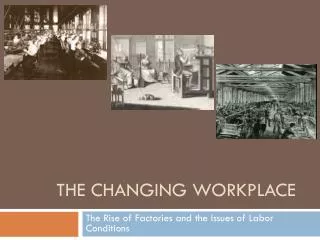
The Changing Workplace Ch. 8, Sect. 4 What problems were created for the emerging industrial workforce by changes in manufacturing in the 1800’s?
SHIFT FROM RURAL TO URBAN MANUFACTURING • Weaving factories end the “putting-out system” of the “cottage-industry” or production in homes • Decline of hand-produced goods • Unskilled laborers replaces skilled laborers (masters, journeymen, and apprentices) • Factory products become cheaper, more available • Changes split families & traditional Communities
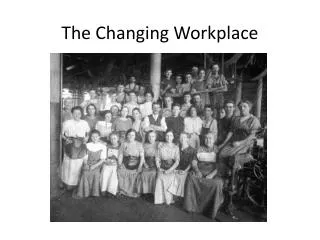
Lowell, Massachusetts:Birthplace of American Industry • 1828: Women are 90% of the mill workforce • Mill owners use women b/c they are paid less • “Mill Girls” are primarily unmarried girls, supervised closely by female supervisors • Opportunity to earn money and leave the farm
STRIKES AT LOWELL • Worked 12 hour day, 6 days a week • Poor wages, poor ventilation, poor conditions • 1834: Mill workers strike over a pay cut; it fails • 1836: Second strike over new pay cuts; it also fails. • 1844: Mill workers form Lowell Female Labor reform Association & petition state legislature. HISTORICAL SIGNIFICANCE: Women begin to organize for political and social change.
Workers Seek Better Conditions • 1835: Nations first general strike in Philly (=a strike by skilled and unskilled workers) • Employers use “strikebreakers” to crush strikes, using poor immigrants • By 1840’s new immigrants are organizing their own strikes: • Irish Dockworkers strike in NY in 1840’s • Ladies Industrial Association, NY in 1845 (SEE HANDOUT ON IMMIGRATION)
National Trades’ Union Workers, or journeymen, begin to organize collectively, rather than by specific trades more bargaining power. • 1834: Journeymen from several industries organize the National Trades’ Union. • Courts declare the Unions illegal. • 1842: Mass. Supreme Court affirms worker’s rights in Commonwealth v. Hunt. • 1860: only 5,000 workers are unionized, though 20,000 participate in strikes