Understanding CFGs and PCFGs: Structure and Probabilities in Context-Free Grammars
This text explores Context-Free Grammars (CFGs) and Probabilistic Context-Free Grammars (PCFGs), detailing their structure and function in syntax generation. CFGs define languages through rules where nonterminal symbols transform into terminal symbols. The addition of probabilities in PCFGs enables more nuanced language modeling, vital in natural language processing (NLP). It discusses grammatical components, including terminal symbols, nonterminal symbols, and the probability functions that guide the interpretation of structures. The text provides examples of rule sets and parses, revealing underlying statistical properties of language generation.

Understanding CFGs and PCFGs: Structure and Probabilities in Context-Free Grammars
E N D
Presentation Transcript
CFGs andPCFGs (Probabilistic) Context-Free Grammars
S NP VP VP V NP VP V NP PP NP NP NP NP NP PP NP N NP e PP P NP people fish tanks people fish with rods N people N fish N tanks N rods V people V fish V tanks P with A phrase structure grammar
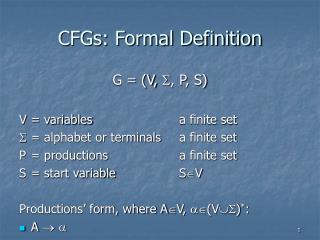
Phrase structure grammars = context-free grammars (CFGs) • G = (T, N, S, R) • T is a set of terminal symbols • N is a set of nonterminal symbols • S is the start symbol (S ∈ N) • R is a set of rules/productions of the form X • X ∈ N and ∈ (N ∪ T)* • A grammar G generates a language L.
Phrase structure grammars in NLP • G = (T, C, N, S, L, R) • T is a set of terminal symbols • C is a set of preterminal symbols • N is a set of nonterminal symbols • S is the start symbol (S ∈ N) • L is the lexicon, a set of items of the form X x • X ∈ P and x ∈ T • R is the grammar, a set of items of the form X • X ∈ N and ∈ (N ∪ C)* • By usual convention, S is the start symbol, but in statistical NLP, we usually have an extra node at the top (ROOT, TOP) • We usually write e for an empty sequence, rather than nothing
S NP VP VP V NP VP V NP PP NP NP NP NP NP PP NP N NP e PP P NP people fish tanks people fish with rods N people N fish N tanks N rods V people V fish V tanks P with A phrase structure grammar
Probabilistic – or stochastic – context-free grammars (PCFGs) • G = (T, N, S, R, P) • T is a set of terminal symbols • N is a set of nonterminal symbols • S is the start symbol (S ∈ N) • R is a set of rules/productions of the form X • P is a probability function • P: R [0,1] • A grammar G generates a language model L.
S NP VP 1.0 VP V NP 0.6 VP V NP PP 0.4 NP NP NP 0.1 NP NP PP 0.2 NP N 0.7 PP P NP 1.0 N people 0.5 N fish 0.2 N tanks 0.2 N rods 0.1 V people 0.1 V fish 0.6 V tanks 0.3 P with 1.0 A PCFG [With empty NP removed so less ambiguous]
The probability of trees and strings • P(t) – The probability of a tree tis the product of the probabilities of the rules used to generate it. • P(s) – The probability of the string sis the sum of the probabilities of the trees which have that string as their yield P(s) = ΣjP(s, t) where t is a parse of s = ΣjP(t)
Tree and String Probabilities • s= people fish tanks with rods • P(t1) = 1.0 × 0.7 × 0.4 × 0.5 × 0.6 × 0.7 × 1.0 × 0.2 × 1.0 × 0.7 × 0.1 = 0.0008232 • P(t2) = 1.0 × 0.7 × 0.6 × 0.5 × 0.6 × 0.2 × 0.7 × 1.0 × 0.2 × 1.0 × 0.7 × 0.1 = 0.00024696 • P(s) = P(t1) + P(t2) = 0.0008232 + 0.00024696 = 0.00107016 Verb attach Noun attach
CFGsand PCFGs (Probabilistic) Context-Free Grammars