Examination of Crystal-Enhanced Coherent Bremsstrahlung in GlueX from CERN NA59 Results
This paper explores the potential of coherent bremsstrahlung, particularly the enhancements recorded in photon emission from crystal alignments near the symmetry axis with the beam. The results from CERN's NA59 experiment are scrutinized, highlighting the clarity in their findings which suggest no enhancement in the hard photon spectrum. Coherent bremsstrahlung is analyzed through established theoretical frameworks, and the implications of recent data for the GlueX collaboration are discussed, illuminating both the challenges and observations in achieving low-energy photon production.

Examination of Crystal-Enhanced Coherent Bremsstrahlung in GlueX from CERN NA59 Results
E N D
Presentation Transcript
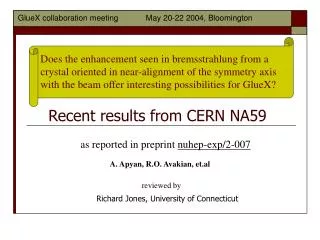
GlueX collaboration meeting May 20-22 2004, Bloomington Recent results from CERN NA59 Does the enhancement seen in bremsstrahlung from a crystal oriented in near-alignment of the symmetry axis with the beam offer interesting possibilities for GlueX? as reported in preprint nuhep-exp/2-007 A. Apyan, R.O. Avakian, et.al reviewed by Richard Jones, University of Connecticut
Motivation • coherent bremsstrahlung is a well-understood process • abundant data over energy range from 100 MeV to 100 GeV • theoretical CB description established since late 60’s • analytic formulas give good agreement with data • for certain configurations CB description has problems • multi-photon processes become important • quasi-classical picture sometimes useful: “channeling” • “channeling” is not a different process, just a different picture • channeling is usually associated with production of low-energy photons • BUT channeling effects are still an area of active experimental study • various sightings have been reported of large enhancements extending up to the end-point, including high degrees of polarization. • recent results from CERN seem to suggest that enhancements of the high-energy end of the photon spectrum might occur, albeit with low polarization.
The NA59 experiment z=0 81.3m
The NA59 experiment Si crystal gonimeter crystal polarimeter pair spectrometer lead glass 178 GeV e- beam beam dump z=0 81.3m
Interpretation of NA59 results • The experimental conditions described in the article fall well within the coherent bremsstrahlung regime. • A generic result for coherent bremsstrahlung is that the gain goes to zero at the end-point. • When read carefully, the paper actually makes no claim of enhancement in the hard part of the photon spectrum. • The photon flux in the paper is much worse for the purposes of GlueX than a simple amorphous radiator.
What is meant by “coherent bremsstrahlung”? k k p p p’ p’ q q • general approach to QED problem of radiation by high-energy electron moving in a matrix of massive charges. • dominated by one-photon exchange diagrams above • integration over q splits into two distinct pieces: • small q: reduces to a discrete sum over allowed reciprocal lattice vectors of virtual Compton scattering terms with no recoil shift • large q: probability that crystal recoils coherently goes to zero, amplitude reverts to form for incoherent process (individual atoms).
Is it coherent over the entire crystal? … not really, it depends on the relative value of k k p electron is temporarily off-shell p’ q L
What happens as k goes to zero? L l • As long as L << l the treatment of sequential one-photon processes is correct • Multi-photon processes are present, but suppressed by powers of a(QED)
What happens as k goes to zero? L l soft photons . “channeling”
now back to NA59 • special crystal orientation: “String-of-strings” • qx=45mr • qy=35mr • CB spectrum has many overlapping low-energy peaks (x < 0.2) • Ltyp = 5 mm • l = 1 mm >> L (far from channeling regime) • beam emittance, mozaic spread, multiple scattering • blur out individual peaks in the low energy (10 GeV) region • probably some channeling from angular divergence • no coherent enhancement above 120 GeV (x=0.66) • very thick radiator: 15 mm ! (many photons per electron)
What the paper actually says: (D. Sober) • single-photon spectrum taken with pair spectrometer • spectrum drops faster than atomic bremsstrahlung • Monte Carlo (red histogram) also predicts rapid drop • paper says lowest data point “saturated” the detector • lowest energy bin is missing from the plot, but… • text says average yield is 14 g/e • 97% of all photons are in bin 0 1/k 0.5 g/e
What the paper actually says: • Key to understanding Fig. 4: What is Etot? • “total radiated energy” • It is the sum of the energy of some dozen photons • This is not the intensity spectrum of individual photons in the beam. • An electron radiates away ~2/3 of its energy in 15 mm which is only 0.7 rad. len. • Most of this energy goes into low-energy (~10 GeV) photons.
Summary • Using crystal radiators aligned near an axis can produce large yields of low-energy photons. • Claims are sometimes heard that these enhancements extend all the way to the end-point of the photon spectrum. • CERN experiment NA59 was carried out to look for such enhancements and check the polarization of hard photons. • Carefully interpreted, the NA59 results show neither an enhancement of the hard component of the photon spectrum nor any evidence of polarization there. • Hard bremsstrahlung is associated with large momentum exchange and is not enhanced by many soft interactions.