MUONS!
MUONS!. How muons are created Detecting methods Muon half life and decay rate Muon decay data Problems with the data and muons. What are we going to talk about?.

MUONS!
E N D
Presentation Transcript
How muons are created • Detecting methods • Muon half life and decay rate • Muon decay data • Problems with the data and muons What are we going to talk about?
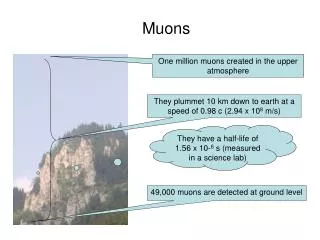
Protons from the cosmic rays interact with the atoms in the upper atmosphere and create a shower of particles which decay further to produce muons. How muons are created.
Muon Enters A flash is emitted Decays into an electron The scintillator detects the electron and emits a flash Detecting methods
dN-Change in muons N(t)-Number of muons at given time. λ-Decay rate dt-change in time == hence t= t=0 => No= Our = 0.388 N(t)=No Meaning that half life= 2.6 Muon Half Life and Decay Rate.
02/07/2014 – 03/07/2014 Muon decay data
Systematic errors: • The PMT cable was faulty which fluctuated the results giving inaccurate results as it affected the rate of decay. • Affecting flux rate. “11’o’clock drop” Problems with the data
When the person is standing up: • 0.155*(6719073/24)*16=515129 (±0.5) • When the person is lying down: 0.885*(6719073/24)*8=1982127 (±0.5) 0.5m 0.5m Shoulder: 0.115m2 Standing: 0.885m2 0.23m 0.177m How many muons pass through you everyday?
Muons decayed in detector Muons passed through your body Total muons through detector = 3946 How many interact with you
They have a half life of 2.2µ yet they can still travel 660m. • This is due to time dilation, as muons travel 98% the speed of light. • Therefore, time slows down. Problems with muons