Understanding Enzymes and Metabolic Pathways: Roles, Reactions, and Regulation
150 likes | 279 Vues
This article explores the intricate roles of enzymes in metabolic pathways, highlighting how they facilitate chemical changes in living organisms. Each pathway consists of specific stages, catalyzed by unique enzymes that convert substrates into products while managing energy changes. Learn about catabolic and anabolic processes, the significance of cyclic pathways, and the mechanisms of enzyme inhibition and activation, including competitive and non-competitive inhibitors. Additionally, we delve into allostery, wherein the end products of pathways regulate enzyme activity, ensuring efficient metabolic processes.


Understanding Enzymes and Metabolic Pathways: Roles, Reactions, and Regulation
E N D
Presentation Transcript
Metabolic Pathways • Chemical changes in living things often occur with a number of ____________________ • Each stage has its own _________ • ________ pathways _____________ molecules and release energy • _____________ pathways _____________ molecules
Chain Pathways • ___________is specific to ____________. Sub. 1 changes to product 1. • ________is specific to product 1 which now becomes _________ and is converted to product 2. • __________ is specific to product 2/substrate 3 and converts it to the __________. • Ex. Glycolysis • Catabolic or Anabolic?
Cyclic Pathways • _____________enters the cycle • ____________combines the regenerated intermediate (inter.) 4 with the _________ __________to produce inter.1 • Enzyme 2 is ________to inter.1 and converts it to inter. 2 • _________is specific to inter. 2 which it converts to the product and inter. 3 • Enz. 3 + inter. 3 = __________ • Inter. 4 is then used again to ______________ Ex. Krebs cycle and Calvin cycle Catabolic or Anabolic?
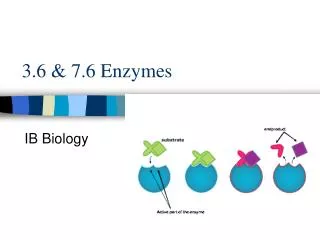
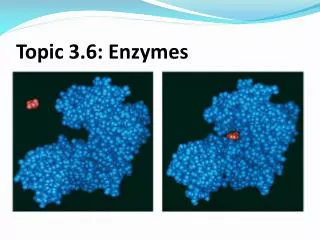
Induce Fit Model • Active site is not an ________ for substrate; instead the site _____________to the shape of the substrate • By changing __________of the enzyme, it actually places mechanical stress on the substrate the enables bonds to ________easier • This _________ active site allows for ________ specificity of some enzymes (ex. Proteases being able to dissolve many dif. proteins in detergents)
Activation Energies • __________________– energy that must be gained by a molecule to break bonds and carry out a reaction • _______________– a reaction where the amount of energy given out is greater than the amount needed to start a reaction (activation energy) • __________________– reaction where the amount of energy given off is less than that needed to start the reaction
Exergonic Reaction • Enzymes lower the activation energy needed to ____________________ • Energy gained by the reaction is not different than when ___________; however, since the amount needed to start it is less there is more ___________
Endergonic Reaction • Enzyme lowers the ___________________needed to start this reaction • The amount of free energy at the end of this reaction is not more than the energy needed to start the reaction; overall _____________
Enzyme Inhibition • _________________– chemical substance that reduces or completely prevents the function of an enzyme • Some enzyme inhibitors are ____________and some are ______________
Competitive Inhibitor • _____________and ___________ are chemically very similar • The inhibitor can bind to the ______________of the enzyme • While inhibitor is in the active site enzyme will __________________ • Ex. In the Citric Acid Cycle (Krebs) succinate is converted to fumarate. Malonate binds to the enzyme responsible to the above reaction which inhibits it.
Non-competitive Inhibition • Substate and inhibitor are not ___________________ • Inhibitor binds to the enzyme at ________________than active site. • This changes the _____________ of the enzyme. It may slow or totally prevent the _______________while bound • Ex. - DDT blocks enzymes in nervous system - Anti-biotics block enzymes in bacteria that make cell wall
Below comp. Inhib. ___________will always be binding w/ substrate. _____________ the conc. of substrate lessens the effect of the inhibitor Above non-comp. Inhib. Some enzymes affected and will forever more ___________reaction. Rate _________ and lower.
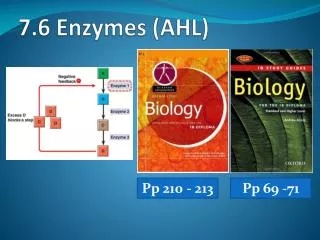
Allostery and Metabolic Pathways • ________________– when the last product in a metabolic pathway inhibits the enzyme that starts the pathway • _______________– the enzyme that is inhibited by the end product of a reaction
Allostery • Enzyme has two sites; ________and ___________ • When end product of pathway is _________ it can encounter and bind the ______________of the 1st enzyme in the pathway • This changes the conformation of the enzyme which _____ or ______ the reaction • Ensures no _________of end product or intermediate products
Allostery • Examples • ATP inhibition of phosphofructokinase (enzyme that drives glycolysis) • Inhibition of ATCase (enzyme that catalyses the first step of pyrimidine synthesis during nucleic acid building)