Critical Approach To Early Childhood Programs
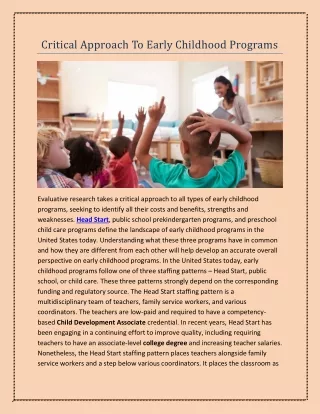
Evaluative research takes a critical approach to all types of early childhood programs, seeking to identify all their costs and benefits, strengths and weaknesses. Head Start, public school prekindergarten programs, and preschool child care programs define the landscape of early childhood programs in the United States today. Understanding what these three programs have in common and how they are different from each other will help develop an accurate overall perspective on early childhood programs. In the United States today, early childhood programs follow one of three staffing patterns u2013 Head Start, public school, or child care. These three patterns strongly depend on the corresponding funding and regulatory source. The Head Start staffing pattern is a multidisciplinary team of teachers, family service workers, and various coordinators. The teachers are low-paid and required to have a competency-based Child Development Associate credential. In recent years, Head Start has been engaging in a continuing effort to improve quality, including requiring teachers to have an associate-level college degree and increasing teacher salaries. Nonetheless, the Head Start staffing pattern places teachers alongside family service workers and a step below various coordinators. It places the classroom as one component alongside parent support, health and mental health services, and social services referrals. The public school staffing pattern places teachers in charge, supervised by a building principal. There are no family service workers or coordinators of other services, except sometimes school nurses. Relative to Head Start or child care, teachers are better-paid and better-educated, generally with a teaching certificate based on a bacheloru2019s degree. Because of this staffing, the classroom teacher predominates, and there is less emphasis on separate positions that provide parent support, health and mental health services, and social services referrals. Unlike child care, both Head Start and public school prekindergarten programs typically have part-day classes for children and, thus, can serve twice as many children by having double sessions, serving one classroom group in the morning and the other in the afternoon. The apparent efficiencies, however, severely limit the time available for non-classroom activities, such as teacher planning and home visits, which may be critical to program effectiveness. Both Head Start and public school staffing patterns are designed to help children develop and prepare for school. While the public school pattern focuses primarily on education, the Head Start pattern provides multiple services with intermediate goals, such as parentsu2019 economic self-sufficiency, that may become ends in themselves. Indeed, some Head Start practitioners consider Head Start to be primarily a parent program. The child care staffing pattern resembles the director and teaching staff portion of the Head Start pattern. Unlike Head Start, there are no family service workers and no coordinators of other services. The staffing is set up for teachers to take care of children. The teachers surely engage in some educational activity and may well aspire to do more, but they are not accorded the status and compensation that public school teachers receive. While Head Start and public school programs are fully supported by public tax dollars, child care programs are paid for primarily by families; government subsidies are either partial or nonexistent. Child care hours are longer, in response to family needs. The relatively low cost of child care staffing is done in the interest of greater affordability and responsiveness to families. Each of these staffing patterns involves tradeoffs relative to the other two. Public schools employ tax dollars to give teachers greater responsibility and compensation than Head Start or child care teachers. Head Start employs tax dollars to give children and families access to other support services as well as education. Child care programs, with no or partial support from tax dollars, strive to take care of children at a level of quality that families can afford. Head Start, public school prekindergarten programs, and preschool child care programs all have the goal of contributing to childrenu2019s development, and all value and support parent involvement in the service of contributing to childrenu2019s development. But each definitely offers its own variations on these themes. Head Start also has the goal of encouraging and supporting familiesu2019 self-sufficiency by referrals to needed social, health, and mental health services as well as support for adult literacy, employment, and freedom from drug abuse. Head Startu2019s adult goals generally support childrenu2019s development, but can on occasion compete with, or even replace, this goal. Public school prekindergarten programs focus single-mindedly on contributing to childrenu2019s development, but may narrow this goal to focus only on childrenu2019s academic readiness for school. Preschool child care programs really have as their primary goal taking care of preschool aged children while parents are otherwise occupied. Contributing to childrenu2019s development is an enhancement of this primary goal, which is at the discretion of the caregivers involved, their supervisors, and the parents who support these programs. Quality practices are either structural or process. Structural practices are established program characteristics, such as group size, staff-child ratio, and teacher qualifications. Process practices are the behaviors that adults and children engage in during the program. Structural practices are more easily set by rules and regulations, but process practices directly affect childrenu2019s behavior and development, so that they mediate any effects of structural practices on childrenu2019s development. Head Start has family self-sufficiency as a secondary goal, so Head Start program quality is defined as those practices that contribute to childrenu2019s development or familiesu2019 self-sufficiency. Public school prekindergarten programs place special emphasis on childrenu2019s school readiness as the defining construct of their contribution to early childhood development, so the quality of these programs emphasizes those practices that help prepare children for school. Preschool child care programs place a premium on those practices that take care of children while parents are otherwise occupied. These programs can be evaluated against the common core of criteria for all three u2013 structural and process practices that contribute to childrenu2019s development. In addition, Head Start programs can examine practices that contribute to familiesu2019 self-sufficiency; public school prekindergarten programs can concentrate on practices that contribute to childrenu2019s readiness for school; and preschool child care programs can examine practices that enable parents to be otherwise occupied when they need to be. Of course, it would also be possible to apply these idiosyncratic criteria to the other types of programs. We could examine how well public school prekindergarten programs and preschool child care programs contributed to familiesu2019 self-sufficiency, a particularly apt criterion for programs serving families living in poverty. We could examine how well any of these programs contributed to childrenu2019s readiness for school, a criterion that is beginning to break boundaries anyway because of our national interest in it. We could examine how well Head Start and public school prekindergarten program meet familiesu2019 child care needs. Such ideas go to the heart of the question of whether the differentiation of types of early childhood programs is a good idea or not. Should publicly funded programs be expected to meet familiesu2019 child care needs, or should we continue with our national policy of no or partial subsidy of such programs? Should early childhood programs address familiesu2019 self-sufficiency needs for families not living in poverty? Until these questions are answered, however, we can stick with the universal definition of early childhood program success u2013 structural and process practices that contribute to childrenu2019s development. Nonetheless, it is very difficult, perhaps impossible, to compare the effectiveness of Head Start, public school prekindergarten, and preschool child care programs for the simple reason that they serve different populations. The main entry criterion for Head Start is that families have poverty-level incomes. Low family income may be a factor in the entry criteria for public school prekindergarten programs, but it is only one factor among others; and low family income may play no role at all in the entry criteria for preschool child care. The criterion for enrollment in preschool child care is that the family needs child care to permit parents to be otherwise employed, a criterion that tends to increase family income and also renders impossible the idea of randomly assigning children who need child care to an unserved control group. On the other hand, it is possible to compare the quality of the various types of early childhood programs. The question is not which funding source is best, but rather what funding levels per child and staffing and governance patterns lead to programs of the best structural and process quality. Such comparisons lead to thorny dilemmas that need to be faced. Funding levels and policies interact in complex ways, making interpretation of findings difficult. It would be quite reasonable to conduct evaluative research on all types of early childhood programs together. But it will only happen if those who fund evaluative research rise above their positions of employment for one or the other of these programs. Federal and state legislators are well-positioned to be asking questions of all these programs, but they need to figure out ways to transcend program positioning in the funding agencies. All of us who care about young children should find ways to place their education and welfare above the status of the programs in which they find themselves. Jeff C. Palmer is a teacher, success coach, trainer, Certified Master of Web Copywriting and founder of https://Ebookschoice.com. Jeff is a prolific writer, Senior Research Associate and Infopreneur having written many eBooks, articles and special reports. Source: https://ebookschoice.com/critical-approach-to-early-childhood-programs/
82 views • 5 slides