
Trends in Mortality by Income in Urban Canada (1971-1996)
E N D
Presentation Transcript
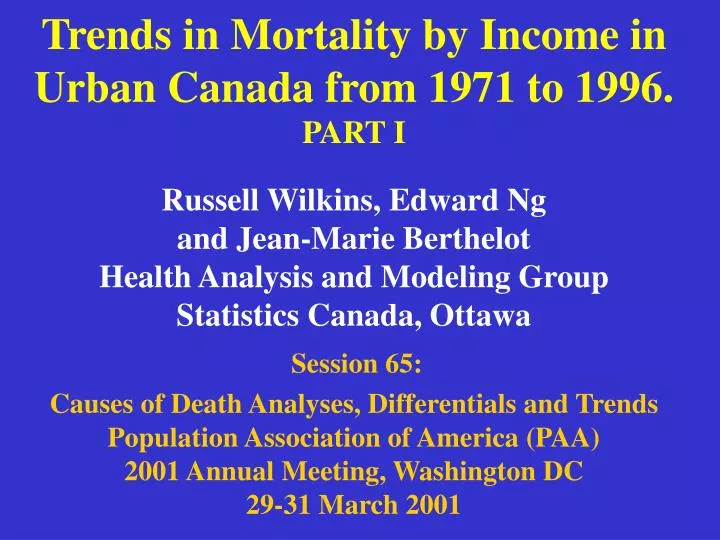
Trends in Mortality by Income in Urban Canada from 1971 to 1996.PART IRussell Wilkins, Edward Ng and Jean-Marie BerthelotHealth Analysis and Modeling GroupStatistics Canada, Ottawa Session 65: Causes of Death Analyses, Differentials and Trends Population Association of America (PAA) 2001 Annual Meeting, Washington DC 29-31 March 2001
Russell Wilkins Health Analysis and Modeling Group Statistics Canada, RHC-24A Ottawa ON K1A OT6 Tel: 1-613-951-5305 Fax: 1-613-951-3959 Email: russell.wilkins@statcan.ca
Data inclusions and exclusions 1971 1986 1991 1996 • Total deaths 81,465 101,104 101,960 122,104 • Reg not retr’d 18 0 0 0 • Res health inst 5,912 14,824 16,156 19,185 • CT not coded 1,375 923 17 1,010 • CT excluded 109 213 97 122 • Age or sex unkn 61 4 8 1 • Deaths retained 73,990 88,140 93,328 101,786 • Non-inst pop (mil) 11.6 14.9 16.5 17.7
Infant Mortality per 1,000
Q5/Q1 Mortality Ratios Age (yrs)