Mastering Fractions and Percentages: A Comprehensive Guide
160 likes | 271 Vues
This unit focuses on essential concepts of fractions and percentages, including addition, subtraction, multiplication, and division of fractions. Learn how to find a common denominator when working with fractions, solve problems involving compound interest to understand investment growth, and tackle reverse percentage problems to uncover original prices before tax. This educational guide will enhance your mathematical skills and confidence, making complex operations simple and manageable. Dive into each section to master the use of fractions and percentages in real-life applications.


Mastering Fractions and Percentages: A Comprehensive Guide
E N D
Presentation Transcript
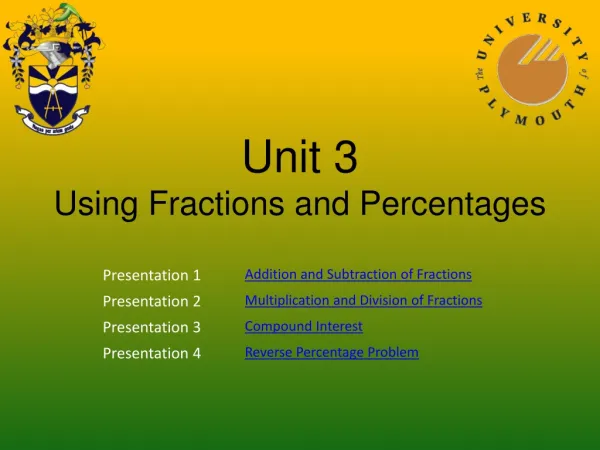
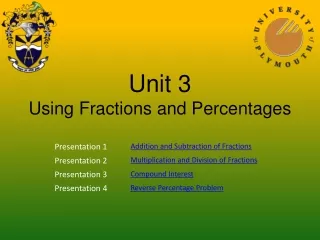
Unit 3Using Fractions and Percentages Addition and Subtraction of Fractions
When adding or subtracting fractions, you must have the same denominator. Example: Lowest common multiple of 4 and 5 is 20 (or )
When adding or subtracting fractions, you must have the same denominator. Example:
You have finished viewing the presentationAddition and Subtraction of FractionsPlease choose an option
Unit 3Using Fractions and Percentages Multiplication and Division of Fractions
The rule is: Example: 3 is a common factor in both the numerator and denominator
The rule is: Example:
Example: First Calculate Thus
You have finished viewing the presentationMultiplication and Division of FractionsPlease choose an option
Unit 3Using Fractions and Percentages Compound Interest
How much is $140 worth after 10 years in an account that pays 5% interest per year When An is the total amount after investing A0 for n years at r%
You have finished viewing the presentationCompound InterestPlease choose an option
Unit 3Using Fractions and Percentages Reverse Percentage Problem
The price of a computer is $1398, including GCT at What was the price of the computer without GCT? To add 16.5% GCT, you multiply by 1.165 To remove GCT, you divide by 1.165 Computer price
You have finished viewing the presentationReverse Percentage ProblemPlease choose an option