Progressive Photon Mapping
Learn about Progressive Photon Mapping, an innovative algorithm for realistic lighting in computer graphics, overcoming memory limitations of traditional photon mapping while enhancing visual quality.

Progressive Photon Mapping
E N D
Presentation Transcript
Progressive Photon Mapping 최인창(Inchang Choi) KAIST (Korea Advanced Institute of Science and Technology)
Intro: MC based methods • can simulate specular and diffuse material • Problems: • Caustics (LS+DE) • SDS paths (LSDSE)
Intro: Photon Mapping • Two pass algorithm • First pass: Photon Tracing • Second pass: Ray Tracing using the photon maps • Problem: • Scenes dominated by caustics ->We don’t have infinite memory
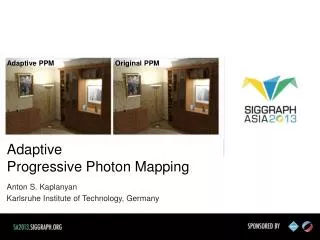
Intro: Progressive Photon Mapping • An extension of Photon Mapping • Include SDS paths with arbitrary accuracy without infinite memory • Multi-pass algorithm • First Pass: Ray Tracing • Subsequent Passes: Photon Tracing
Photon Mapping:First Pass: Photon Tracing • Shoot photons from the light source • -using MC technique and Russian Roulette • -store photons in K-d tree • Position, incident direction, flux • Manage two photon maps • Caustic map • Global photon map Caustic mapphotons Global mapphotons From John C. Hart’s ppt
Photon Mapping:Second Pass: Ray Tracing • Trace rays • Calculate illumination using two photon maps DA = pr2 Use the nearest N photons to estimate L at point x From John C. Hart’s ppt
Photon Mapping:Second Pass: Ray Tracing Direct Illumination Diffuse Indirect Illumination Specular Illumination Caustic Illumination From Michael Kaiser and Christian Finger’s ppt
How can it be improved? • 1. Make the number of photons very large • (lim n->∞) • Use an Iterative method • 2. Reduce the radius r • (limt r-> 0) • Reduce the radius every iteration
Progressive Photon MappingFirst Pass: Ray Tracing • Shoot a ray from eye to the scene • Trace the path until the first non-specular surface • Store the hit point if the surface has non-specular(diffuse) component in the BRDF
Progressive Photon MappingFirst Pass: Ray Tracing • A Hit Point Structure These are updated each subsequent passes
Progressive Photon MappingSubsequent Pass: Photon Tracing • In each Pass • Trace a given number of photons into the scene
Progressive Photon MappingSubsequent Pass: Photon Tracing • After each Pass • Loop all hit points • :Find the photons within the radius • :refine the estimate of the illumination • (Reduce R, increase N, update τ)
A Video Result • http://www.youtube.com/watch?v=zg9NcCw53iA
Thank you for listening • Any Questions?