DENTURE BASES
Denture bases play a crucial role in supporting and retaining denture teeth, ensuring optimal stress distribution while enhancing aesthetics. Commonly made from acrylic resin, these bases can be easily relined and repaired, although they may suffer from dimensional instability and hygiene issues due to porosity. Metal bases, while providing better thermal conductivity and hygiene, are less aesthetic and may show through. Flange extensions are essential for support and retention, while proper denture tooth selection is vital for harmony and occlusion.
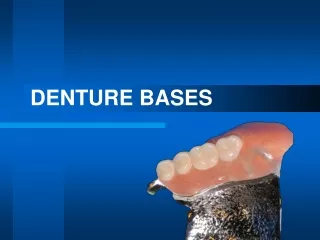

DENTURE BASES
E N D
Presentation Transcript
Functions • Support & retain denture teeth • Stress distribution - surface area • Improve esthetics
Materials • Acrylic Resin • Metal
Acrylic Resin Bases • Most common type • Allows relining of the base to maintain mucosal support
Advantages • Esthetically superior to metal • Ease of repair
Disadvantages • Dimensional stability - warpage • Lower strength/wear resistance than metal • Porous - hygiene • Low thermal conductivity
Metal Bases • Small edentulous spaces • no room for gridwork • Less esthetic (metal show through)
Advantages • Thermal conductivity • Swallowing hot substances • Improved thermal perception
Advantages • Accuracy & Dimensional Stability • Minimal warpage (casting imbibtion) • Minimal need for posterior palatal seal • Minimal abrasion
Advantages • Hygiene • Metal less porous than resin • Less food, plaque & calculus accumulation
Advantages • Weight and Bulk • Metal bases can be cast thinner than resin bases while maintaining adequate strength
Flange Extension • Tooth- tissue supported partial dentures • Extend maximally for support & retention • No overextension or impingement on movable border tissues
Flange Extension • Class I & II RPD’s • Posterior extension same as a complete denture • Hamular notches, retromolar pads
Flange Extension • Soft Tissue Undercuts
Acrylic Resin Finish Lines • Internal & external finish lines should not coincide
Replacement Teeth • Acrylic denture teeth • Cause less attrition than porcelain • Easier to arrange, modify & adjust
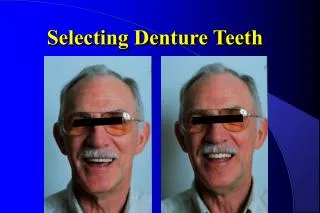
Replacement Teeth • Tooth Form • Harmonize with adjacent teeth • Shade, shape, length, width & occlusal form • Occlusion almost always requires adjustment Poor Occlusogingival Harmony Good Occlusogingival Harmony
Video Clips • Cl III Path of Insertion • Cl IV Path of Insertion