
Absolute Monarchs and the Foundations of French Absolutism
E N D
Presentation Transcript
Unit III Ch. 16 & 17
Absolute Monarchs • Absolutism: a gov’t in which all power is held by the ruler • Divine Right: idea that rulers were chosen by God to rule, that they only answered to God and God alone • Biggest threat of an absolute monarch=the nobility
How did they rule? • Higher taxes • -bureaucracies made up of career officials appointed by and responsible to the king alone -generally elite/middle class members • -maintained permanent standing armies -peace and wartime • -glorified the state over all other aspects of culture • -used war and expansionist foreign policy to distract from national problems
The Foundations of French Absolutism: Henry IV, Sully and Richelieu -Henry IV “Henry the Great” (r. 1589-1610) -civil wars, poor harvests, depopulation = weak France -promised a “chicken in every pot” -converted to Catholicism -regain support of the pope -Edict of Nantes (1598) –aka: Law of Concord -granted Protestants (mainly Huguenots) the freedom of public worship -wanted to earn the trust of the Protestants
Henry IV lowered taxes on peasants and his chief minister, Sully, streamlined tax collection • Cardinal Richelieu was appointed to the council of ministers in 1628 during the reign of Louis XIII (r. 1610-1643) • Richelieu curbed the power of the nobility by reshuffling the royal council, leveling castles, and executing aristocratic conspirators against the king
Cardinal Richelieu continued • Divided France into thirty-two generalities • Each ruled by an intendant • Recruited soldiers, supervised tax collection, watched local nobility, and regulated economic activity • In 1685, Louis XIV moved to end Protestant independence put in place by his grandfather, Henry IV • Revocation of the Edict of Nantes
Mazarin and the Fronde (1648-1653) • Richelieu’s successor, Mazarin provoked an aristocratic rebellion • The Fronde, as the rebellion became known as, convinced King Louis XIV that the only alternative to anarchy (absence of law) was absolute monarchy • he would be skeptical of the nobility throughout his reign due to the events of the Fronde
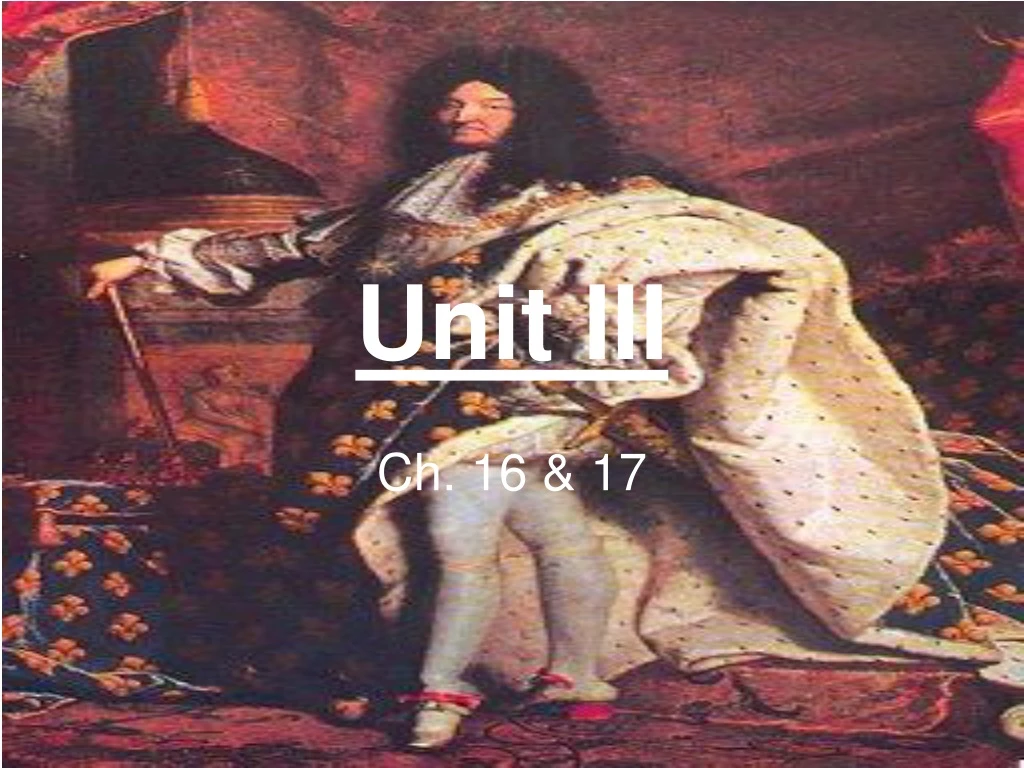
The Absolute Monarchy of Louis XIV (r.1643-1715) • The Sun King • convinced he was God’s appointed ruler for France -longest reign in European history -72 years -“L;etat, c’est moi” = “I am the state”
Louis’ government structure: -highly structured -centered at Versailes -why?: -to keep his nobility under control -did not have a first minister -feared another “Richelieu”
Louis’ Financial and Economic Management • Weakness • Limitations on royal absolutism • Taxation • Dealings with the Estates of Burgundy • First estate: Clergy • Second estate: nobility • Third estate: merchants, artisans, peasants • Deal with the nobility: • Old agreement that the king could freely tax the common people so long as he did not tax the nobility • Tax burden then fell on the Third Estate
Jean-Baptiste Colbert (1619-1683) • Controller of general finances • Believed France should be self-sufficient • Sell abroad and buy nothing in return • Adhered to the idea of mercantilism • Strict regulation of manufactured goods • Built a worldwide reputation for the uniformly high quality of French goods • Built a large navy to protect France’s empire • By 1683 he had balanced the budget and promoted prosperity • Textile industry superior
Revocation of the Edict of Nantes (1685) • Louis XIV sought to control religion • Outlawed Protestantism • Protestant churches destroyed • Schools closed • Ordered the Catholic Baptism of Huguenots (exiled if they would not renounce their faith) • Why? • French monarchy did not want to permit religious tolerance • No religious pluralism for the French; one country, one faith
Results: -thousands of Huguenots emigrated to Protestant friendly areas of Europe and America -hurt France’s economy -took away tax payers
Wars of Aggression • Why? • Land, glory, gold • Louis wanted Spanish and Austrian Hapsburg lands on France’s eastern borders • War of Devolution (1667-1668) • Spanish Netherlands/Burgundy • United provinces against France • Balance of power • Against the Dutch (1672-1679) • Ended with the Peace of Nijmegen • Grand Alliance against Louis • War of the League of Augsburg (1689-1697) • War of the Spanish Succession (1701-1713) • Charles II dies from Spain; Louis wanted his nephew king (Phillip of Anjou, no one else does) Phillip remains king of Spain • Maintains balance of power; ends French expansionist policy
Death of the Sun King • 1715 • At the time of his death, France was in huge debt, yet, it was one of Europe’s most powerful nations • Precursor to the economic problems leading France to its revolution (1789)
Central European Monarchs Clash • Thirty Years’ War (1618-1648) • Fought in Germany between the Protestant League and the Catholic League • Conflict over territory, religion, and power among European ruling families • Hapsburg Triumphs • First 12 years • Troops from Austria and Spain defeated Protestant armies • Put down the Czech uprising • Defeated German Protestants
Hapsburg Defeats • driven out of No. Germany by Protestant Gustavus Adolphus • Cardinal Richelieu and Mazarin supported Protestants • Oxymoron: • Cardinal (CATHOLIC) supporting Protestants • Why? • To weaken the Hapsburgs of course
Peace of Westphalia (1648) **Hubdate** • What did it do? • 1) weakened Hapsburg rule in Spain and Austria • 2) strengthened France with German territory • 3) made German princes independent • 4) ended religious wars in Europe • 5) introduced a new method of peace negotiations • 6) ends religious warfare **Modern State begins**
Prussia and Austria Clash • Frederick William (1712-1786) • Steps toward absolutism: • Created a strong army • Introduced permanent taxation • Called themselves kings • Weakened representative assemblies of their territories • Junkers: • Prussia’s landowning nobility • War of the Austrian succession • Frederick II wanted Austrian lands • Maria Theresa (Austrian queen) fights back • Seven Years’ War (1756-1763) • Aka: French and Indian War • Maria signs treaty with French kings • Frederick signs treaty with Britain (Austria’s former ally) • Fought in India, Europe and No. America • Britain emerges as the real victor
Russian Czars increase power • Ivan III (1462-1505) • conquered area around Moscow • Liberated Russia from Mongols • Centralized Russian gov’t • Laid the foundations for absolutism in Russia
Russian Czars: Ivan IV “The Terrible” • 1533-1584 • Boyars • Russia’s landowning nobility • Wife: Anastasia from the Romanov family • Killed in 1560 • Began Ivan’s “bad period” • Turned against the boyars (killed many) • 1581: killed his heir to the throne, his son • Ivan IV died, Ivan V takes over (not so good) • Ivan V dies w/o an heir • 1613: representatives elect Michael Romanov as czar, begins the Romanov dynasty (1613-1917)
Russian Czars: Peter the Great • 1672-1725 • Reformer and absolute ruler • The “Grand Embassy” • Peter visits the West • Westernization: wants Russia to change
Peter rules absolutely • Peter’s reforms • Increased absolute rule • Brought the Russian Orthodox church under state control • Hired European officers to modernize the army (imposed heavy taxes) • Believed in the importance of education • Built a new capital, St. Petersburg, along the sea
England: Constitutional Monarchy • James I (England, 1603-1625) • Upheld divine right • Struggle with Parliament over money • Was a Calvinist, yet would not make Puritan reforms (led to their emigration from England)
England: Charles I • Asked Parliament for money; when they wouldn’t give it to him, he dissolved it • Petition of Right 1628 • Charles agreed to: • 1) not imprison subjects w/o due clause • 2) not levy high taxes w/o Parliament’s consent • 3) not house soldiers in private homes (quartering) • 4) not impose martial law in peace time
English Civil War1642-1649 • Charles I wanted both his kingdoms (England and Scotland which he inherited from his mother, Mary Queen of Scots) to follow one religion • The Scots rebel • Parliament would not support a war against the Scots This leads to….
WAR!!!!! (civil war, of course) • Royalists/Cavaliers = support Charles I • Roundheads = Puritan supporters of Parliament (Oliver Cromwell) • Cromwell led the New Model Army to defeat the Cavaliers • Put Charles I on trial for treason • Executed in 1649 (publicly) • Cromwell then ruled until 1658, but was kind of a dictator Royalists Roundheads
Restoration and Revolution • Charles II succeeded Cromwell and restored the monarchy • James II and the Glorious Revolution • Came to power in 1685 (Catholic) • Parliament members overthrew James II • Put Mary (daughter of James) and William of Orange on the throne • Bloodless revolutions (1688-**Hubdate**)
England: Political changes after 1688 • Constitutional monarchy developed • Laws limit the ruler’s power **unique to England at this time** • Bill of Rights 1689 • Listed what a ruler could not do; rights of the citizens • Cabinet system develops • Group of gov’t ministers representing parliament **democracy develops**
Unit IV Ch. 18 & 19
Scientific Revolution • A major change in European thought starting in the mid-1500s in which the study of the natural world began to be characterized by careful observation and the questioning of accepted beliefs
Roots of the Revolution • Before the Sci. Rev. • Scholars decided what was true based on the teachings of ancient authors and/or the Bible • Few questioned • Most believed: • The earth was the center of the universe • Idea came from Aristotle (Greek Philosopher) **Geocentricism** Earth
A New Way of Thinking • Based on observation and a willingness to question accepted beliefs • Developed from: • The Renaissance • Age of Exploration • Printing Press
Characteristics of the Sci. Rev. • Use of observation and trial and error in developing scientific discoveries • Goes against church truths -contradicts church doctrine • 16th and 17th century scientists built on the idea and findings of those who came before them
Copernicus Galileo
Heliocentricism: sun in the middle of the universe; proposed by Copernicus
Enlightened Absolutism • Enlightened Despot/Absolutist: • Rulers who tried to justify their absolute rule by claiming to rule in the people’s interest by making good laws, promoting human happiness, and improving society
Examples of Enlightened Despots • Frederick the Great (Prussia) • Improved educational system • Got rid of torture of accused criminals • Allowed for the freedom of religion and press
Peter the Great (Russia) • Westernized Russia • Improved educational system • St. Petersburg
Catherine the Great (Russia) • created hospitals • Codified Russian law -Pugachev serf uprising in 1773 led her to reverse some reforms
Maria Theresa (Austria) • Est. national army • Limited the power of the Church • Revised the tax system • Limited the power of the lord over serfs • Improved ed. system
Joseph II (Austria) • Abolished serfdom • Tolerance of Calvinists and Lutherans • Eliminated restrictions placed on Jews • Abolished capital punishment
Agricultural Revolution • The application of new agricultural techniques that allowed for a large increase in productivity in the 18th century • Pre-Revolution: • Poor harvests, “famine foods,” widespread illness, open-field system (rotated crops and communal share of the land)—(communism?) • Revolution: • Crop rotation critical • Enclosure movement • Originated in the “Low Countries”—Holland • Will lead to the growth of the Atlantic economy and slave trade