
Mollusks
E N D
Presentation Transcript
Mollusks Odyssey Expeditions
Jason Buchheim Phylum Molluska • Means “soft body” • Includes clams, snails, sea slugs, and octopus • Freshwater, marine and terrestrial • Most have external shell of calcium carbonate
Radula General Characteristics • Posses a mantle • Circulates water through organism • Feeding, propulsion, and/or shell production • Gills or lungs found in mantle cavity • Posses a muscular foot • Used to crawl with • Tentacles in cephalopods • Posses a radula • Tongue bearing teeth used for feeding (like a conveyor belt)
Classes • Class Monoplacophora • Class Polyplacophora • Class Aplacophora • Class Gastropoda • Class Bivalvia • Class Scaphopoda • Class Cephalopoda
Class Monoplacophora • Relic class • Many fossilized mollusks belong to this class • Less than 20 extant (living) species • Single cap-like shell • Creeping foot • Found in deep water (2000 to 7000m)
Class Polyplacophora • Chitons • Oval in shape • Eight over lapping plates • Creeping foot that adheres tightly to rocky surfaces • Mostly inhabit rocky intertidal zones • Feed on algae and other organisms on the rocks
Ventral View Class Aplacophora • Worm-like • Small (<5mm) • No shell, have calcareous spicules in mantle • Inhabit deep water (200 to 7000m) • Creep or burrow • Very little known
Class Gastropoda • Largest class of mollusks (30,000 species) • Snails and snail-like organisms • Well developed head with tentacles and eyes • Most possess single coiled asymmetrical shell • Most crawl with foot but some swim with it
Gastropod Subclasses • Subclass Prosobranchia • Subclass Opisthobranchia • Subclass Pulmonata
Subclass Prosobranchia • Mantle cavity anterior • Marine • Shelled • Many have operculum (hard disc attached to the foot that covers the opening to the shell for protection) • Some use mantle as camouflage • Includes conchs, whelks, cones, abalone, and drills • Herbivores and carnivores
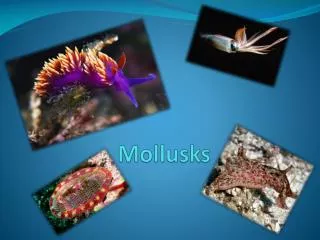
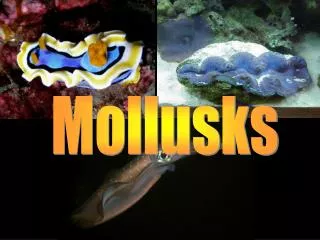
Subclass Opisthobranchia • Mostly marine • Shell reduced or lacking • Mantle cavity on right side, posterior, or even lacking • Some respire through skin or external gills • Mantle generally colorful and ornate • May have modified foot to swim with • Typically few inches in length • Includes sea hares, nudibranchs, sea slugs • Herbivores and carnivores (have very specific diets)
Subclass Pulmonata • Typically terrestrial • Shelled (except slugs) • Mantle cavity modified into lungs • Includes terrestrial snails, freshwater snails and slugs • Typically herbivores
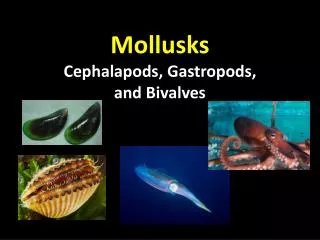
Class Bivalvia • Consists of two hinged shells or valves • Gills used for filter feeding as well as respiration (water brought in and out by siphons while buried in sediment) • The mantle of some contains tentacles and eye spots to detect movement. • No head • Second largest molluscan class (8,000 extant species) • Freshwater and marine • Includes cockles, mussels, oysters, scallops, and clams
Class Scaphopoda • Tusk or tooth shell (looks like elephant’s trunk) • Marine • Single elongated tube-like shell. • Burrowing • Modified foot for digging • Possess tentacles to capture interstitial (organisms found among sediment grains) • 2-6 cm long
Jason Buchheim NOAA Class Cephalopoda • Elongated • Highly cephalized • Well developed nervous system • Foot modified into specialized arms and tentacles for prey capture • Shell external, internal, or absent • Includes nautilus, squid, octopus, and cuttlefish • Propulsion created by expulsion of water from mantle cavity
Cephalopod Subclasses • Subclass Nautiloidea • Subclass Ammonidea • Subclass Coleoidea
Subclass Nautiloidea • Nautilus • Only 4 extant species (most are extinct) • Multi-chambered external shell • Gas in chambers provides buoyancy (connected by central siphuncle canal and separated by septa) • Siphuncle used to add or remove gas to chambers • Many arms (~90) for prey capture
Subclass Ammonidea • All members extinct • Coiled, external, multi-chambered shells • Complex septa with siphuncle found along outer axis of shell • Index fossils
NOAA Jason Buchheim Subclass Coleoidea • Squid, octopus, cuttlefish • Internal or lacking shell • Eight arms with suckers • Squid and cuttlefish also have two tentacles for prey capture • Ability to camouflage is exceptional • Have large nerve cells used in research
Resources • Barnes, Robert D. and Edward Ruppert. Invertebrate Zoology: Sixth Edition. Fort Worth: Saunders College Publishing, 1994 • Humann, Paul and Ned Deloach. Reef Creature Identification: Florida Caribbean Bahamas. Florida: New World Publications, Inc., 2003 • Kinsella, John, Drew Richardson and Bob Wohlers. Life on an Ocean Planet. California: Current Publishing Corp., 2006 • Taylor, Walter K. and Robert L. Wallace. Invertebrate Zoology: A Laboratory Manual Sixth Edition. New Jersey: Prentice Hall, 2002