Earley’s Algorithm for Parsing Efficiency
Learn about Earley’s Algorithm for efficient parsing, incremental processing, and left context constraints. Explore an overview and examples of implementing this algorithm in natural language processing.

Earley’s Algorithm for Parsing Efficiency
E N D
Presentation Transcript
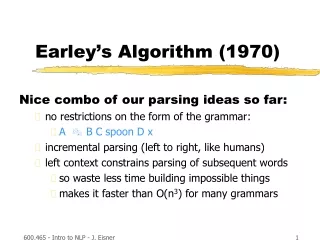
Earley’s Algorithm (1970) Nice combo of our parsing ideas so far: • no restrictions on the form of the grammar: • A B C spoon D x • incremental parsing (left to right, like humans) • left context constrains parsing of subsequent words • so waste less time building impossible things • makes it faster than O(n3) for many grammars 600.465 - Intro to NLP - J. Eisner
… … 600.465 - Intro to NLP - J. Eisner
A A D + = j k B C D E B C D E j i k i A B C . D E A B C D . E Overview of Earley’s Algorithm • Finds constituents and partial constituents in input • A B C . D E is partial: only the first half of the A 600.465 - Intro to NLP - J. Eisner
Overview of Earley’s Algorithm • Proceeds incrementally, left-to-right • Before it reads word 5, it has already built all hypotheses that are consistent with first 4 words • Reads word 5 & attaches it to immediately preceding hypotheses. Might yield new constituents that are then attached to hypotheses immediately preceding them … • E.g., attaching D to A B C . D E gives A B C D . E • Attaching E to that gives A B C D E . • Now we have a complete A that we can attach to hypotheses immediately preceding the A, etc. 600.465 - Intro to NLP - J. Eisner
Our Usual Example Grammar ROOT S S NP VP NP Papa NP Det N N caviar NP NP PP N spoon VP VP PP V ate VP V NP P with PP P NP Det the Det a 600.465 - Intro to NLP - J. Eisner
0 Papa 1 ate 2 the 3 caviar 4 with 5 a 6 spoon 7 First Try: Recursive Descent ROOT S VP VP PP NP Papa V ate S NP VP VP V NP N caviar P with NP Det N PP P NP N spoon Det the NP NP PP Det a • 0 ROOT . S 0 • 0 S . NP VP 0 • 0 NP . Papa 0 • 0 NP Papa . 1 • 0 S NP . VP 1 • 1 VP . VP PP 1 • 1 VP . VP PP 1 • 1 VP . VP PP 1 1 VP . VP PP 1 oops, stack overflowed • OK, let’s pretend that didn’t happen. • Let’s suppose we didn’t see VP VP PP, and used VP V NP instead. “goal stack” 600.465 - Intro to NLP - J. Eisner
0 Papa 1 ate 2 the 3 caviar 4 with 5 a 6 spoon 7 First Try: Recursive Descent ROOT S VP V NP NP Papa V ate S NP VP VP VP PP N caviar P with NP Det N PP P NP N spoon Det the NP NP PP Det a • 1VP . V NP 1after dot = nonterminal, so recursively look for it (“predict”) • 1V . ate 1after dot = terminal, so look for it in the input (“scan”) • 1 V ate . 2after dot = nothing, so parent’s subgoal is completed (“attach”) • 1 VP V . NP 2 predict (next subgoal) • 2NP . ... 2do some more parsing and eventually ... • 2NP ... . 7we complete the parent’s NP subgoal, so attach • 1 VP V NP .7 attach again • 0 S NP VP .7 attach again • 0 ROOT . S 0 • 0 S . NP VP 0 • 0 NP . Papa 0 • 0 NP Papa . 1 • 0 S NP . VP 1 after dot = nonterminal, so recursively look for it (“predict”) 600.465 - Intro to NLP - J. Eisner
0 Papa 1 ate 2 the 3 caviar 4 with 5 a 6 spoon 7 First Try: Recursive Descent ROOT S VP V NP NP Papa V ate S NP VP VP VP PP N caviar P with NP Det N PP P NP N spoon Det the NP NP PP Det a • 0 ROOT . S 0 • 0 S . NP VP 0 • 0 NP . Papa 0 • 0 NP Papa . 1 • 0 S NP . VP 1 • 1VP . V NP 1 • 1V . ate 1 • 1 V ate . 2 • 1 VP V . NP 2 • 2NP . ... 2 • 2NP ... . 7 • 1 VP V NP .7 • 0 S NP VP .7 implement by function calls: S() calls NP() and VP(), which recurse must backtrack to try predicting a different VP rule here instead But how about the other parse? 600.465 - Intro to NLP - J. Eisner
0 Papa 1 ate 2 the 3 caviar 4 with 5 a 6 spoon 7 First Try: Recursive Descent ROOT S VP V NP NP Papa V ate S NP VP VP VP PP N caviar P with NP Det N PP P NP N spoon Det the NP NP PP Det a • 1VP . V NP 1 • 1 V . ate 1 • 1 V ate . 2 • 1 VP V . NP 2 • 2NP . ... 2do some more parsing and eventually ... • 2NP ... . 4... the correct NP is from 2 to 4 this time (but might we find the one from 2 to 7 instead?) • 0 ROOT . S 0 • 0 S . NP VP 0 • 0 NP . Papa 0 • 0 NP Papa . 1 • 0 S NP . VP 1 • 1VP . VP PP 1 we’d better backtrack here too! (why?) 600.465 - Intro to NLP - J. Eisner
0 Papa 1 ate 2 the 3 caviar 4 with 5 a 6 spoon 7 First Try: Recursive Descent ROOT S VP V NP NP Papa V ate S NP VP VP VP PP N caviar P with NP Det N PP P NP N spoon Det the NP NP PP Det a • 1VP . VP PP 1 1VP . VP PP 1 1VP . VP PP 1 oops, stack overflowed no fix after all – must transform grammar to eliminate left-recursive rules • 0 ROOT . S 0 • 0 S . NP VP 0 • 0 NP . Papa 0 • 0 NP Papa . 1 • 0 S NP . VP 1 • 1VP . VP PP 1 • 1 VP . VP PP 1 600.465 - Intro to NLP - J. Eisner
Use a Parse Table (= “Chart”) • Earley’s algorithm resembles recursive descent, but solves the left-recursion problem. No recursive function calls. • Use a parse table as we did in CKY, so we can look up anything we’ve discovered so far. “Dynamic programming.” • Entries in column 5 look like (3, S NP . VP) (but we’ll omit the etc. to save space) • Built while processing word 5 • Means that the input substring from 3 to 5 matches the initial NP portion of a S NP VPrule • Dot shows how much we’ve matched as of column 5 • Perfectly fine to have entries like (3, S is it . true that S) 600.465 - Intro to NLP - J. Eisner
Use a Parse Table (“Chart”) • Entries in column 5 look like (3, S NP . VP) • What does it mean if we have this entry? • Unknown right context: Doesn’t mean we’ll necessarily be able to find a VP starting at column 5 to complete the S. • Known left context: Does mean that some dotted rule back in column 3 is looking for an S that starts at 3. • So if we actually do find a VP starting at column 5, allowing us to complete the S, then we’ll be able to attach the S to something. • And when that something is complete, it too will have a customer to its left … just as in recursive descent! • In short, a top-down (i.e., goal-directed) parser: it chooses to start building a constituent not because of the input but because that’s what the left context needs. In the spoon, won’t build spoon as a verb because there’s no way to use a verb there. • So any hypothesis in column 5 could get used in the correct parse, if words 1-5 are continued in just the right way by words 6-n. 600.465 - Intro to NLP - J. Eisner
new hypotheses old hypotheses Operation of the Algorithm • Process all hypotheses one at a time in order.(Current hypothesis is shown in blue, with substring.) • This may add to the end of the to-do list, or try to add again. • Process a hypothesis according to what follows the dot – just as in recursive descent: • If a word, scan input and see if it matches • If a nonterminal, predict ways to match it (we’ll predict blindly, but could reduce # of predictions by looking ahead k symbols in the input and only making predictions that are compatible with this limited right context) • If nothing, then we have a complete constituent, so attach it to all its customers (shown in purple). 600.465 - Intro to NLP - J. Eisner
A j i B C D E One entry (hypothesis) … column j (i, A B C . D E) which action? current hypothesis (incomplete) All entries ending at j stored in column j, as in CKY 600.465 - Intro to NLP - J. Eisner
D j i bludger j j Predict column j (i, A B C . D E) current hypothesis (incomplete) (j, D . bludger) new entry to process later A B C D E 600.465 - Intro to NLP - J. Eisner
k=j+1 in this example … column k D D + = bludger j k bludger j j bludger j k Scan column j (j, D bludger .) (i, A B C . D E) new entry to process later (j, D . bludger) Current hypothesis (incomplete) 600.465 - Intro to NLP - J. Eisner
j k Attach column j … column k (j, D bludger .) (i, A B C . D E) current hypothesis (complete) D 600.465 - Intro to NLP - J. Eisner
j k A A + = j i k i B C D E B C D E Attach column j … column k (j, D bludger .) (i, A B C . D E) current hypothesis (complete) customer (incomplete) (i, A B C D . E) new entry to process later D 600.465 - Intro to NLP - J. Eisner
0 Papa 1 ate 2 the 3 caviar 4 with 5 a 6 spoon 7 Our Usual Example Grammar ROOT S S NP VP NP Papa NP Det N N caviar NP NP PP N spoon VP VP PP V ate VP V NP P with PP P NP Det the Det a 600.465 - Intro to NLP - J. Eisner
Remember this stands for (0, ROOT . S) initialize
Remember this stands for (0, S . NP VP) predict the kind of S we are looking for
predict the kind of NP we are looking for (actually we’ll look for 3 kinds: any of the 3 will do)
predict the kind of NP we’re looking for but we were already looking for these so don’t add duplicate goals! Note that this happened when we were processing a left-recursive rule.
attach the newly createdNP (which starts at 0) to its customers (incomplete constituents that end at 0 and have NP after the dot)
scan(this time we fail since Papa is not the next word)
attach (again!)
attach (again!)