
Position Analysis of a 4-Bar RRRR Linkage Using Complex Numbers

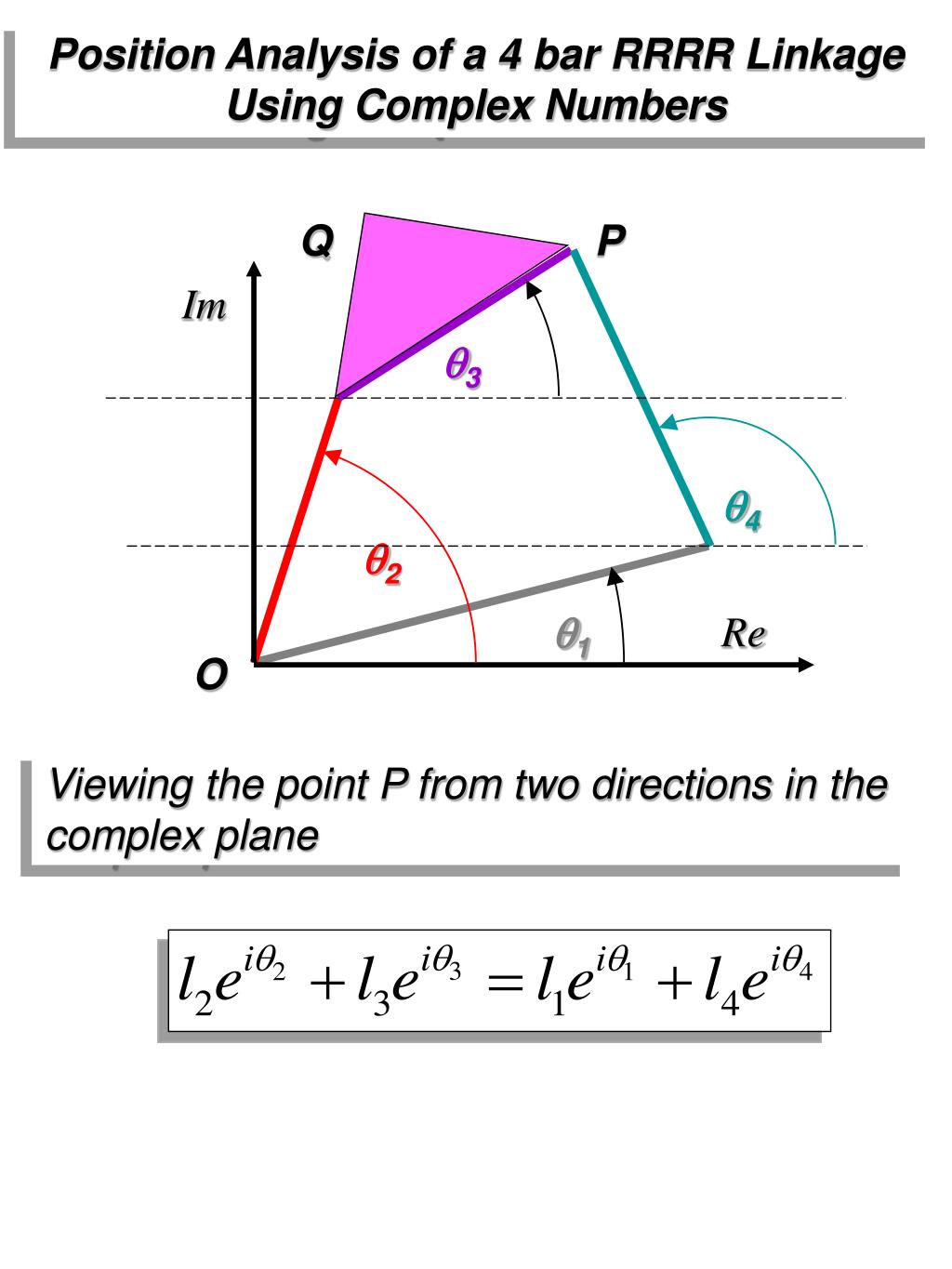
This study explores the position analysis of a 4-bar RRRR linkage by leveraging complex numbers. The approach involves viewing point P from two directions in the complex plane, effectively separating real and imaginary parts. We formulate two scalar equations to solve for two unknowns. By rearranging terms, and employing squaring and adding techniques, we simplify the analysis. The resulting calculations yield two roots, allowing us to determine the quadrant for angle q3 based on the signs of sine and cosine. This method offers a robust framework for analyzing complex linkages.
Télécharger la présentation 
Politique de téléchargement : le contenu du site vous est fourni TEL QUEL pour votre information et votre usage personnel ; il ne peut être vendu, concédé sous licence ni partagé sur d’autres sites sans l’accord de son auteur.Le contenu vous est fourni TEL QUEL, pour votre information et votre usage personnel uniquement. Téléchargez la présentation en cliquant sur ce lien. Lors du téléchargement, si vous ne parvenez pas à télécharger une présentation, l’éditeur a peut-être supprimé le fichier de son serveur.Pendant le téléchargement, si vous ne parvenez pas à obtenir une présentation, le fichier a peut-être été supprimé par l’éditeur.
F I N