Unit 1 - Lecture 1 Microscope Objectives
This lecture focuses on the essential role of microscopes in microbiology, emphasizing the variety of microorganisms studied through these instruments. Key objectives include mastering correct microscope techniques, such as oil immersion, and understanding the different types of microscopes: simple, compound, light, stereomicroscopes, and electron microscopes. Additionally, we cover storage do's and don'ts, magnification details, and resolution for effective observation. A well-structured understanding of these topics is vital for anyone engaged in the field of microbiology.

Unit 1 - Lecture 1 Microscope Objectives
E N D
Presentation Transcript
Unit 1 - Lecture 1 Microscope Objectives 1-1 Understand that microbiology includes a diversity of microorganisms requires the regular use of the microscope. 1-2 Be able to use correct microscope technique, including the use of the oil immersion lens.
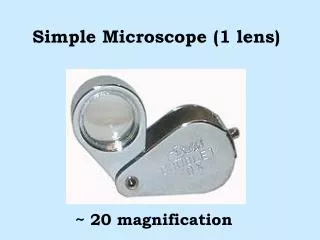
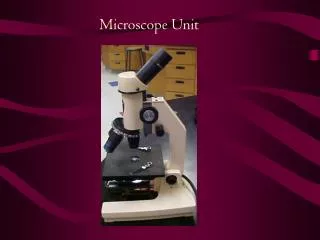
Types of Microscopes Different types of microscopes 1. Simple - single lens (10-20X) (perfected by Anton van Leeuwenhoek) 2. Compound - 2 lens (year = 1590) 3. Compound light - (2,000X) 4. Stereomicroscope - used for large specimens (60X)
4. Electron - uses a beam of electrons instead of light (1932) a. Transmission - T.E.M. shows internal structures (200,000X) b.Scanning - S.E.M. shows the surface (100,000X)
Microscope Do’s and Don’t’s How to Store: - remove cover/ replace cover - wrap cord around base - make sure stage is all the way up - make sure shortest lens is toward stage
Other information small(4X) medium(10X) large - high (40X) 4 X 10 10 X 10 10 X 40 Total magnification = 40 = 100 = 400 - resolution - ability to distinguish between 2 objects - magnification - apparent increase in size of the organism - microscope makes a virtual image - upside down and backwards
View Diameters 40 – 4.45 mm 100 – 1.78 mm 400 - .45 mm 1000 - .178 mm