Download
1 / 3
0 likes | 0 Vues
Onsite Calibration: Making Sure Accurate Pressure and Temperature Level Dimensions<br><br><br>Imagine

E N D
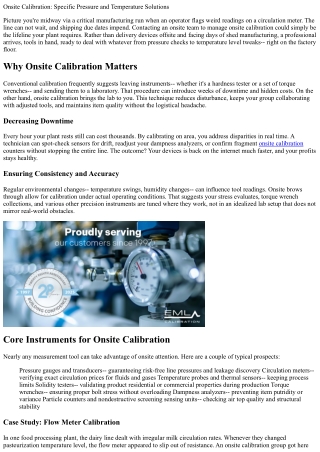
Onsite Calibration: Specific Pressure and Temperature Solutions Picture you're midway via a critical manufacturing run when an operator flags weird readings on a circulation meter. The line can not wait, and shipping due dates impend. Contacting an onsite team to manage onsite calibration could simply be the lifeline your plant requires. Rather than delivery devices offsite and facing days of shed manufacturing, a professional arrives, tools in hand, ready to deal with whatever from pressure checks to temperature level tweaks-- right on the factory floor. Why Onsite Calibration Matters Conventional calibration frequently suggests leaving instruments-- whether it's a hardness tester or a set of torque wrenches-- and sending them to a laboratory. That procedure can introduce weeks of downtime and hidden costs. On the other hand, onsite calibration brings the lab to you. This technique reduces disturbance, keeps your group collaborating with adjusted tools, and maintains item quality without the logistical headache. Decreasing Downtime Every hour your plant rests still can cost thousands. By calibrating on area, you address disparities in real time. A technician can spot-check sensors for drift, readjust your dampness analyzers, or confirm fragment onsite calibration counters without stopping the entire line. The outcome? Your devices is back on the internet much faster, and your profits stays healthy. Ensuring Consistency and Accuracy Regular environmental changes-- temperature swings, humidity changes-- can influence tool readings. Onsite brows through allow for calibration under actual operating conditions. That suggests your stress evaluates, torque wrench collections, and various other precision instruments are tuned where they work, not in an idealized lab setup that does not mirror real-world obstacles. Core Instruments for Onsite Calibration Nearly any measurement tool can take advantage of onsite attention. Here are a couple of typical prospects: Pressure gauges and transducers-- guaranteeing risk-free line pressures and leakage discovery Circulation meters-- verifying exact circulation prices for fluids and gases Temperature probes and thermal sensors-- keeping process limits Solidity testers-- validating product residential or commercial properties during production Torque wrenches-- ensuring proper bolt stress without overloading Dampness analyzers-- preventing item putridity or variance Particle counters and nondestructive screening sensing units-- checking air top quality and structural stability Case Study: Flow Meter Calibration In one food processing plant, the dairy line dealt with irregular milk circulation rates. Whenever they changed pasteurization temperature level, the flow meter appeared to slip out of resistance. An onsite calibration group got here
equipped with a portable comparison standard. Within hours, they confirmed the meter's performance at numerous flow factors, made great adjustments, and recorded the outcomes. Production resumed without a 2nd change lost, and the top quality department got self-confidence in every container of milk generated. Ideal Practices for Smooth Onsite Calibration Whether it's your very first time scheduling a go to or you're a seasoned pro, these ideas will help you get the most from an onsite calibration solution: Prepare a list of tools and their last calibration days. Clear workspace around critical sensing units and gauges for simple accessibility. Keep in mind any type of recent abnormalities or changes in your maintenance logs. Coordinate with shift supervisors to plan calibration without disrupting crucial procedures. Collect environmental information-- ambient temperature and moisture-- to share with the professional. Environmental Considerations Onsite calibrations should not neglect the truth that your plant flooring isn't a cleanroom. Dirt particles can influence sensing unit heads, and warm from close-by devices can alter readings. An excellent calibration partner utilizes nondestructive methods and takes environmental variables into account, occasionally also bringing mobile guards or units to separate crucial zones. Documents and Traceability Among the most significant benefits of specialist tool calibration solutions is the strenuous documentation. After calibrating each gadget-- be it a torque wrench or a pressure transmitter-- you obtain a certificate outlining as-found and as-left readings, standards made use of, and measurement uncertainty. This documentation not just pleases audits yet likewise aids you track instrument efficiency fads gradually. Real-World ROI of Onsite Calibration It's very easy to see calibration as an expense facility. But when you consider stopped recalls, less guarantee claims, and undisturbed production, the numbers start to look very different. Below's just how onsite calibration can pay for itself: Reduced downtime-- every hour saved adds profits. Improved first-pass return-- fewer flaws slip through. Extended tools life-- much less wear from running out-of-tolerance. Regulative compliance-- preventing penalties and shutdowns. Boosted consumer trust fund-- consistent product top quality. Success Story: Hardness Tester Alignment A metal manufacture store discovered variations in solidity readings on steel components. Sending the solidity tester back to a main laboratory would have stopped manufacturing for a week. Instead, an onsite check out recalibrated the indenter force and confirmed the gauge block criteria. The store returned to machining within 24 hours, and the welding division reported more powerful, much more reputable components.
Choosing the Right Onsite Calibration Partner Not all company are equal. Search for technicians that focus on both field calibrating and nondestructive verification approaches. Accreditations from national assessment institutes, experience with a vast array mechanical calibration of tools, and quick turn-around times are essential variables. A good companion will also offer preventative upkeep advice, aiding you intend your next see before a gauge wanders out of specification. Conclusion In today's affordable production landscape, accuracy and uptime work together. Onsite calibration bridges the gap in between lab-grade precision and real-world efficiency. Whether you're verifying sensors in a chemical plant or making certain the right torque on essential assemblies, the advantages are instant: less downtime, constant item quality, and solid audit tracks. For teams all set to experience the distinction, EML Calibration is a source that incorporates deep technical experience with fast, trustworthy area solution. Name: EML Calibration Address: 998 Elm Hill Pike, Nashville, TN 37210, United States Phone: (888) 846-4614 Website: https://www.emlcalibration.com/