Understanding Population Dynamics: Size, Density, and Dispersion Patterns
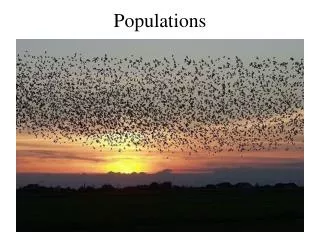
This overview explores the essential concepts of populations in ecology, focusing on population size, density, and dispersion patterns. A population is defined as a group of individuals of a single species inhabiting the same area. We analyze their dispersion through three patterns: uniform, clumped, and random. Uniform dispersion occurs due to repulsing factors, clumped arises from attracting factors, and random results from a lack of these influences. Population size is the total count of organisms, while population density measures their distribution per unit area, often determined using mark-recapture methods.

Understanding Population Dynamics: Size, Density, and Dispersion Patterns
E N D
Presentation Transcript
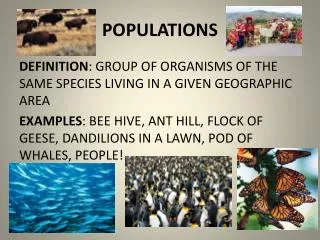
Population – a group of individuals of a single species that live in the same area.
Dispersion • One metric used to analyze populations is to look at their dispersion, the pattern of spacing in a population
Uniform arises when there are repulsing factors that push organisms apart • Clumped arises when there are attracting factors (such as herding) that pull organisms together. • Random occurs when there is a lack of attracting or repulsing effects.
Population Size and Density • Population size – total number of organisms in a population • Often measured with mark-recapture • Population density – number of organisms per unit area