The Pythagorean Theorem
50 likes | 165 Vues
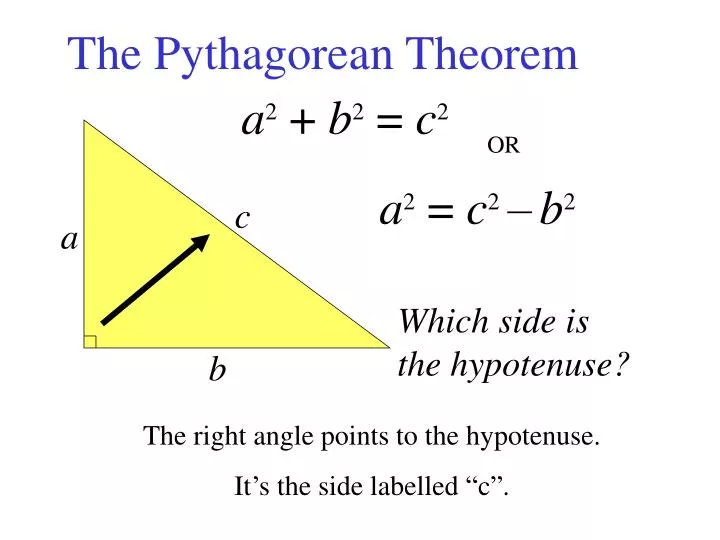
This guide delves into the Pythagorean Theorem, which states that in a right triangle, the square of the length of the hypotenuse (c) is equal to the sum of the squares of the lengths of the other two sides (a and b). It provides step-by-step calculations to find the hypotenuse and a missing side. For instance, to calculate the hypotenuse using side lengths of 8 and 6, the formula c² = a² + b² is applied. It also includes practical examples, such as determining the diagonal of a rectangle and the height of a cone, making the theorem easy to understand.


The Pythagorean Theorem
E N D
Presentation Transcript
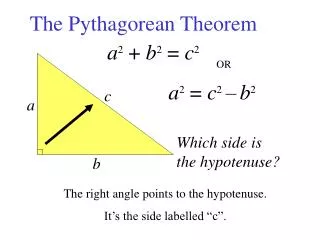
c a b The Pythagorean Theorem a2 + b2 = c2 OR a2 = c2–b2 Which side is the hypotenuse? The right angle points to the hypotenuse. It’s the side labelled “c”.
c 6 8 When calculating the hypotenuse, we add the area of the squares of the other two sides. Calculate side c. c2 = a2 + b2 c2 = 82+ 62 c2 = 64+ 36 c2 = 100 c = 10
x 7 12 Calculate the length of side x. b2 = c2– a2 x2 = 122– 72 a b x2 = 144– 49 x2= 95 c When calculating a side, we determine the difference of the area of the square of the hypotenuse and the area of the square of the known side. x= 9.7
12 cm 15 cm The length and width of a rectangle are 12 cm and 15 cm. Calculate the length of the diagonal. c2 = a2+ b2 d 2 = 152+ 122 d d 2 = 225+ 144 d 2 = 369 d = 19.2 cm
13 cm h 5 cm Tanya is making a party hat using a cone made out of paper. Determine the height of the cone. b2 = c2– a2 h2 = 132– 52 h2 = 169– 25 h2 = 144 h = 12 cm