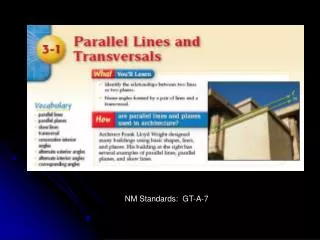
Understanding Parallel Lines, Skew Lines, and Transversals in Geometry
250 likes | 368 Vues
This comprehensive guide explains the concepts of parallel lines, skew lines, and transversals in geometry. It describes parallel lines as coplanar lines that do not intersect and introduces the notation for parallelism. The document also distinguishes skew lines as lines that do not intersect and are not parallel, always lying on different planes. Various examples illustrate how to identify transversals and the relationships of angles formed by these lines, including corresponding angles, alternate interior angles, and consecutive interior angles, enhancing your understanding of these critical geometric principles.


Understanding Parallel Lines, Skew Lines, and Transversals in Geometry
E N D
Presentation Transcript
Parallel Lines Coplanar lines that do not intersect. The symbol || means “is parallel to” The red arrows also mean “is parallel to”
Parallel Planes Two or more planes that do not intersect. R Q
Skew Lines Two or more lines that do not intersect but are not parallel. Lines m& n are skew lines n m Skew lines are always on different planes.
Example 1-1a Name all planes that are parallel to plane AEF. Answer: plane BHG
Name all segments that intersect Answer: Example 1-1b
Name all segments that are parallel to Answer: Example 1-1c
Name all segments that are skew to Answer: Example 1-1d
Transversal A line that intersects two or more other lines in a plane at different points The two or more lines do NOT have to be parallel.
Example 1-2a BUS STATION Some of a bus station’s driveways are shown. Identify the sets of lines to which line v is a transversal. Answer: If the lines are extended, line v intersects lines u, w, x, and z.
Example 1-2b BUS STATION Some of a bus station’s driveways are shown. Identify the sets of lines to which line yis a transversal. Answer: lines u, w, x, z
Example 1-2c BUS STATION Some of a bus station’s driveways are shown. Identify the sets of lines to which line uis a transversal. Answer: lines v, x, y, z
Example 1-2d BUS STATION Some of a bus station’s driveways are shown. Identify the sets of lines to which line wis a transversal. Answer: lines v, x, y, z
a. line a b. line b c. line c d. line d Example 1-2e HIKING A group of nature trails is shown. Identify the sets of lines to which each given line is a transversal. Answer: lines c, d, e, f Answer: lines c, d, e, f Answer: lines a, b, d, e, f Answer: lines a, b, c, e, f
Types of Angles Exterior Angles: Angles that lie outside the lines cut by a transversal Interior Angles: Angles that lie between the lines cut by a transversal Consecutive Interior Angles: Pairs of interior angles formed by a transversal that lie on the same side of the transversal and share a side. Alternate Exterior Angles: Pairs of exterior angles formed by a transversal that lie on opposite sides of the transversal. Alternate Interior Angles: Pairs of interior angles formed by a transversal that lie on opposite sides of the transversal. Corresponding Angles: Pairs of angles formed by a transversal that lie on the same side of the transversal, but one is interior and one is exterior.
Identify as alternate interior, alternate exterior, corresponding, or consecutive interior angles. Example 1-3a Answer: corresponding
Identify as alternate interior, alternate exterior, corresponding, or consecutive interior angles. Example 1-3b Answer: alternate exterior
Identify as alternate interior, alternate exterior, corresponding, or consecutive interior angles. Example 1-3c Answer: corresponding
Identify as alternate interior, alternate exterior, corresponding, or consecutive interior angles. Example 1-3d Answer: alternate exterior
Identify as alternate interior, alternate exterior, corresponding, or consecutive interior angles. Example 1-3e Answer: alternate interior
Identify as alternate interior, alternate exterior, corresponding, or consecutive interior angles. Example 1-3f Answer: consecutive interior