Descartes
In his philosophical exploration, Descartes asserts that it is impossible for God to deceive, as deception indicates malice or imperfection. He distinguishes between the faculties of judgement and will, noting that errors arise from the misuse of will beyond the limits of understanding. Descartes emphasizes that our mistakes stem from a disparity between our will and intellect, highlighting the importance of knowledge in moral decision-making. This examination encourages a deeper understanding of truth, error, and divine nature in the context of human faculties.

Descartes
E N D
Presentation Transcript
Descartes Truth
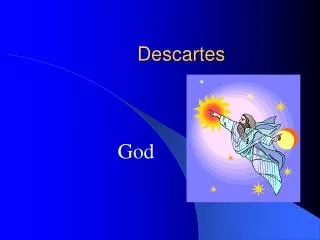
God I recognise that it is impossible that God should ever deceive me. For in every case of trickery or deception some imperfection is to be found; and although the ability to deceive appears to be an indication of cleverness or power, the will to deceive is undoubtedly evidence of malice or weakness, and so cannot apply to God [AT VII 53].
Two Faculties • Faculty of Judgement • Faculty of the Will When I look more closely at myself and inquire into the nature of my errors… I notice that they depend on two concurrent causes, namely on the faculty of knowledge which is in me, and on the faculty of choice or freedom of the will [AT VII 56].
Error So what then is the source of my mistakes? It must be simply this: the scope of my will is wider than that of the intellect, but instead of restricting it within the same limits, I extend its use to matters that I do not understand [AT VII, 58].