Similar Triangles
This educational guide explores the concept of similar triangles, defined by congruent corresponding angles and proportional corresponding sides. Through practical examples, such as ΔMOL ~ ΔREY, learners can fill in the missing angle measures, side proportions, and assess the validity of proportional relationships among various triangles. The guide emphasizes the relevance of similarity theorems and provides engaging fill-in-the-blank exercises to reinforce understanding of triangle similarity and proportional reasoning. Ideal for students and educators alike.

Similar Triangles
E N D
Presentation Transcript
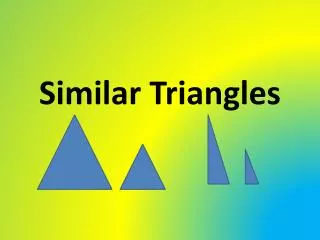
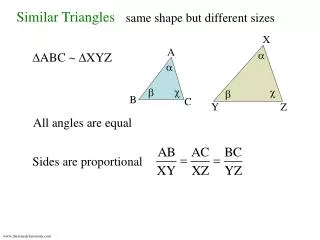
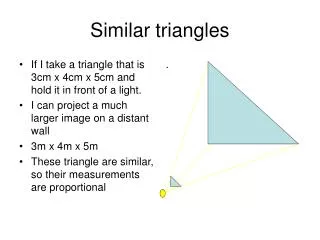
DEFINITION • Two triangles are similar if corresponding angles are congruent and corresponding sides are proportional.
R M 5 2 3 O L 4 E Y 6 TRY THIS OUT!!! • Given: ∆ MOL ∆REY • Fill the blanks: • 1) M __ • 2) O __ • 3) ___ Y
R M 5 2 3 O L 4 E Y 6 TRY THIS OUT!!! • Given: ∆ MOL ∆REY • Fill the blanks: • 4) ML : RY = MO : ? • 5) ML : RY = LO : ? • 6) 2 : 3 = ? : 15 • 7) 4 : 6 = 2 : ?
State whether the proportion is correct for the indicated similar triangles. 1. ∆RST ~∆XYZ • RS : XY = ST : YZ
State whether the proportion is correct for the indicated similar triangles. 2. ∆ABC ~∆DEF • AB : DE = BC : EF
State whether the proportion is correct for the indicated similar triangles. 3. ∆RST ~∆LMK • RT : LM = ST : MK
State whether the proportion is correct for the indicated similar triangles. 4. ∆HIS ~∆DEF • HI : DE = IJ : EF
State whether the proportion is correct for the indicated similar triangles. 5. ∆KLM ~∆PQR • KM : PR = LM : QR
State whether the proportion is correct for the indicated similar triangles. 6. ∆XYZ ~∆UVW • XY : UV = XZ : UW
Complete the proportions 7. ∆ABC ~∆DEF • AB =BC = AC ? ? ?
Complete the proportions 8. ∆KLM ~∆RST • KL =LM = KM ? ? ?
Complete the proportions 9. ∆XYZ ~∆RST • XY =XZ = YZ ? ? ?
Complete the proportions 10. ∆MNO ~∆VWX • VX =VW= WX ? ? ?