Overview of Interim Removable Partial Dentures: Purpose, Design, and Fabrication
Interim removable partial dentures serve as temporary solutions for patients needing dental prosthetics. They are utilized during transitional periods prior to definitive dentures, or under circumstances like sudden tooth loss, financial constraints, or when children’s teeth are still developing. The design includes crucial components like acrylic major connectors and wrought wire clasps, ensuring proper retention and strength. Fabrication involves preliminary impressions, maxillo-mandibular relations, and careful prescription writing to customize the dentures effectively.

Overview of Interim Removable Partial Dentures: Purpose, Design, and Fabrication
E N D
Presentation Transcript
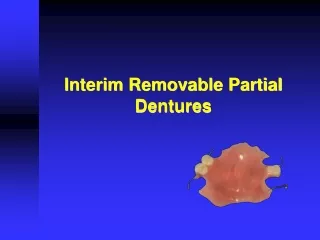
Interim Removable Partial Dentures • Short period of time • Prior to a definitive denture • Acrylic major connector, wrought wire clasps
Indications • Large pulps (can’t fabricate bridge) • Clinical crowns too short • No usable undercuts
Indications • Children - permanent prosthesis would be quickly outgrown • Temporary space maintenance (caries, trauma, congenitally missing teeth)
Indications • Temporary time or financial constraints • Sudden loss of teeth, before sufficient healing has occurred (accidents, after extractions)
Indications • Transitional Denture • Transition to a complete denture • Teeth need to be extracted but not immediately (medically compromised) • Patient is not psychologically prepared
Indications • Treatment Denture • Improve a condition before a definitive denture
Indications • Treatment Denture • Tissue conditioning
Indications • Treatment Denture • Implant healing
Indications • Treatment Denture • Alteration of vertical dimension / occlusion • Determine how patient will respond to changes (TMD) • Surgical Splint • Removal of palatal tori
Interim Prosthesis Fabrication • Preliminary impressions • Design the definitive partial denture (interim denture will use similar design)
Interim Prosthesis Fabrication • Optional Step • Tooth preparations for definitive RPD • New alginate impression
Interim Prosthesis Fabrication • Maxillo-mandibular relations • Articulate casts
Design • Clasps (Wrought wire 0.02”) • Circumferential
Design • Clasps (Wrought wire 0.02”) • Ball clasps • Rest and retentive elements
Design • Clasps (Wrought wire 0.02”) • Adams clasps • Rest and retentive elements
Design • Bracing • Lingual/palatal major connector provides bracing • Contacts teeth at the heights of contour
Design • Rests • Usually wrought wire • Acrylic may be used over cingulum rest seats • Longer term use - cast retainers
Design • Major Connector • Full palatal coverage increases strength & stability • Extend denture to first molar • Retentive clasps embedded into major connector
Prescription Writing • Mark teeth to be extracted on cast & write teeth #’s on prescription • Draw a line around teeth where cast should be surgerized
Prescription Writing • Survey the cast & mark height of contour & retention areas (0.02”) • Indicate type of retentive clasp, rest & bracing
Prescription Writing • Indicate location of rests, retentive & bracing arms • Draw outline of denture base on cast • Identify shade & mould of teeth • State type of occlusion required
Adjustment Commonly adjust: • interproximal extensions (A) • where clasp exits from resin (B) • tissue undercuts (C) (McCracken's Removable Partial Prosthodontics, 11th Edition. Elsevier, 2005)
‘Flipper’ • Slang - No Clasps