Understanding Computer Science: Exam Preparation and Language Hierarchy
150 likes | 303 Vues
Join Dr. Carl Alphonce for a comprehensive review of computer science fundamentals, focusing on machine and assembly languages, high-level languages like Java and Python, and their translation processes. Prepare for the upcoming closed-book exam by discussing key concepts such as sequencing, selection, and repetition in programming languages. Learn about equivalences, computation models like Turing Machines, and proper exam procedures to ensure success. Don't forget your UB card and materials for the exam next Wednesday!

Understanding Computer Science: Exam Preparation and Language Hierarchy
E N D
Presentation Transcript
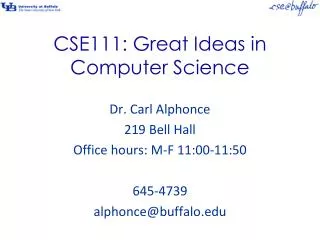
CSE111: Great Ideas in Computer Science Dr. Carl Alphonce 219 Bell Hall Office hours: M-F 11:00-11:50 645-4739 alphonce@buffalo.edu
Announcements • First exam Wednesday next week • Closed book • Bring your UB card • Monday next week: review
Today’s Agenda • Review last lecture’s material • Situate machine language in hierarchy of languages • Discuss exam
cell phones off (please)
Low-level languages • Machine language • 1101000001000010 • Assembly language • ADD R1 R2
High level languages • Java • We can write “x + y” instead of “ADD R1 R2” (in addition to with several MOV instructions) • Others: C#, Erlang, Python, ML, Prolog, Lisp
Translation • LLL LLL is called assembly • there is a 1:1 translation from assembly to machine language • fairly simple process • HLL LLL is called compilation • there is no 1:1 translation • translation is quite complex • optimizations can be applied to make low level code more efficient
Requirements of a PL • Sequencing • Selection • Repetition
Equivalences • Computation models • Turing Machine • Lambda calculus • Programming languages • Java • C# • Prolog • Python
High-level languages • Easier syntax than • Machine language (bit strings) • Assembly language (mnemonic) • Must be translated (compiled) to machine language
Exam • Procedure • Format • Content
Exam procedures • Wait outside room until called in • Sit where there is an exam • Cannot leave until sign-in is completed, at the earliest • We check and collect ID cards • ID card returned when you turn in exam • Exam is closed book, closed notes, closed neighbor • Bring pen/pencil to exam • No electronics permitted (take earbuds out of your ears) • No hats, not drink bottles, pencil cases, etc. • Late arrivals will not be seated – you will receive a zero on the exam
Exam format (exam #1 only) • Some multiple-choice • Some short answer/fill-in-the-blank • Example: (drawn on board)
Exam content • Chapters 0, 1 and 2 from textbook • Lecture material • Strongest emphasis will be put on lecture material • Readings are “fair game”