Introduction to AWK: A Versatile Scripting Language for Text Processing
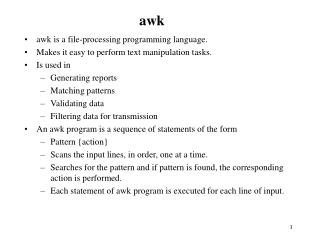
AWK is a powerful programming language designed for text and string manipulation within shell scripts. Ideal for processing input data in records and fields, AWK enables users to perform arithmetic and string operations, manage loops and conditionals, produce formatted reports, and execute Unix commands directly from scripts. With simple syntax and options for advanced usage, it allows for efficient processing and management of data in files. This introduction covers basic commands, examples, and built-in variables that make AWK a valuable tool for programmers and system administrators.


Introduction to AWK: A Versatile Scripting Language for Text Processing
E N D
Presentation Transcript
awk Dr. Tran, Van Hoai Faculty of Computer Science and Engineering HCMC Uni. of Technology hoai@cse.hcmut.edu.vn
What is "awk"? • awk = programming language • text/string manipulation within shell script • useful for input data in records/fields
Typical uses • Perform arithmetic and string operations • Use loops and conditionals • Produce formatted report • Process UNIX command arguments • Execute UNIX commands from script • …
Examples (1) • How to print the first three fields of each record on separate lines • Can we do by shell script and "cut" ? • We can do by "awk" in one command awk -F: '{ print $1; print $2; print $3 }' /etc/passwd
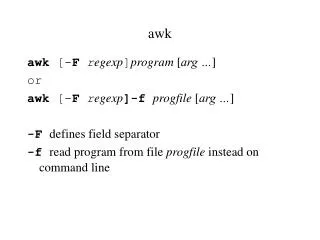
Syntax • Command forms awk [options] 'script' var=value file(s) awk [options] -f scriptfile var=value file(s) • Variable assignment on command-line • "value" can be • string, numeric constant • shell variable ($name) • command substitution (`cmd`)
Options • Standard options • Advanced options (see man pages)
Patterns and procedures • Script is pattern { action } • Both are optional • pattern missing, apply to all lines • action missing, matched line is printed
Procedures • Separated by newline, semicolons • Contained in "{}" • Command groups
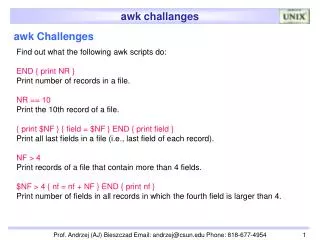
Example (2) • Print first field of each line { print $1 } • Print all lines containing pattern /pattern/ • Print first field of lines containing pattern /pattern/ { print $1 } • Select record having > 2 fields NF > 2
Example (3) • Print only lines which first field matches URGENT $1 ~ /URGENT/ { print $3, $2 } • Print number of lines matching pattern /pattern/ {x++} END {print x} • Sum up column 2 and print the total {total += $2} END { print total}
Example (4) • Print lines containing < 20 characters length($0) < 20 • Print lines of 7 fields and beginning with "Name:" NF==7 && /^Name:/
Example (5) • Print fields in reverse order one per line { for (i=NF; i>=1; i--) print $i; }
awk functions and commands • Control flow • break, continue, do/while, exit, for, if/else, return, while • Arithmetic • rand, sin, cos,… • String • IO • print, printf, getline,…
Exercises is NEXT