Microscopic Dynamics of Hydrogen Transport in Proton Conducting Oxides for Fuel Cells
20 likes | 141 Vues
This research investigates the microscopic dynamics and transport of protons in solid oxides, specifically focusing on enhancing hydrogen conduction at lower temperatures. At high temperatures (700–1000°C), hydrogen conduction relies on breaking the O-H bond, limiting practical applications. However, resonant infrared light significantly boosts hydrogen diffusion rates in rutile TiO2 at room temperature by nine orders of magnitude. This discovery provides new insights into hydrogen transport mechanisms, representing a potential breakthrough for more efficient, cost-effective solid oxide fuel cells and hydrogen production applications.


Microscopic Dynamics of Hydrogen Transport in Proton Conducting Oxides for Fuel Cells
E N D
Presentation Transcript
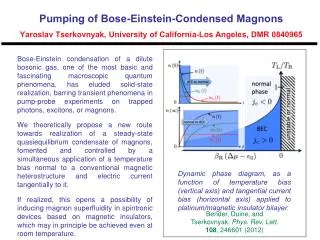
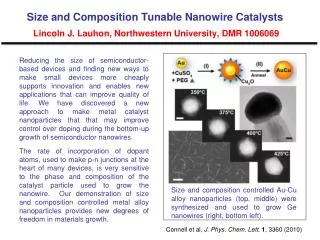
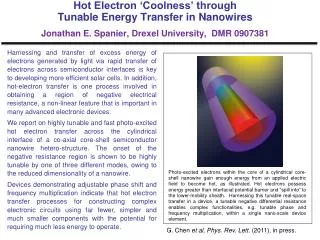
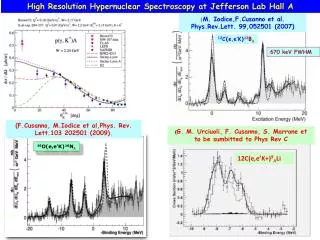
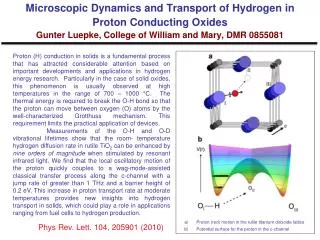
Microscopic Dynamics and Transport of Hydrogen in Proton Conducting Oxides Gunter Luepke, College of William and Mary, DMR 0855081 Proton (H) conduction in solids is a fundamental process that has attracted considerable attention based on important developments and applications in hydrogen energy research. Particularly in the case of solid oxides, this phenomenon is usually observed at high temperatures in the range of 700 – 1000 °C. The thermal energy is required to break the O-H bond so that the proton can move between oxygen (O) atoms by the well-characterized Grotthuss mechanism. This requirement limits the practical application of devices. Measurements of the O-H and O-D vibrational lifetimes show that the room- temperature hydrogen diffusion rate in rutile TiO2 can be enhanced by nine orders of magnitude when stimulated by resonant infrared light. We find that the local oscillatory motion of the proton quickly couples to a wag-mode-assisted classical transfer process along the c-channel with a jump rate of greater than 1 THz and a barrier height of 0.2 eV. This increase in proton transport rate at moderate temperatures provides new insights into hydrogen transport in solids, which could play a role in applications ranging from fuel cells to hydrogen production. Proton (red) motion in the rutile titanium dioxoide lattice Potential surface for the proton in the c-channel Phys Rev. Lett. 104, 205901 (2010)
Microscopic Dynamics and Transport of Hydrogen in Proton Conducting Oxides Gunter Luepke, College of William and Mary, DMR 0855081 Implication: Photo-enhanced fuel cell electrolyte The REU summer research program provides undergraduate students with valuable hands-on experience in the laboratory. In this particular project, the REU student performs computer simulations of photo-enhanced hydrogen transport experiments in proton conducting oxides. This simple idea of resonant infrared illumination of a solid oxide fuel cell (SOFC) electrolyte should increase conductivity and allow for operation at lower temperatures, longer cell life, a wider choice of materials, and increased power. A photo enhanced fuel cell could help reduce device costs and allow for more feasible implementations of these clean, fuel flexible SOFCs. REU student Madeleine Phillips performs computer simulations as part of our laboratory outreach activity.