Exploring CDF's History, Upgraded Apparatus, and Current Results
Dive into the past and present of CDF at Fermilab, from initial design by R. Wilson to Run II upgrades and recent discoveries, along with a glimpse of what's to come. Learn about the Tevatron, luminosity challenges, antiproton cooling, and the CDFII detector enhancements. Discover the significance of measuring the W boson mass and inclusive jet cross-section data from Run I, hinting at potential new physics insights. Join Mario's talk to gain deeper insights into the world of CDF at Fermilab.

Exploring CDF's History, Upgraded Apparatus, and Current Results
E N D
Presentation Transcript
Introduction to CDF • A little history and geography • The NEW machine • The UPGRADED apparatus (for Run II) • A few old results (Run I) • Luminosity matters for Run II Mario’s talk tomorrow: recent results, and what we will do in CDF
Fermilab (FNAL): a bit of history • Conceived and designed by R.Wilson, late ‘60s • Built in Illinois, due to senator E.Dirksen: Batavia, 1 hr W of Chicago • Originally, a 250 GeV proton synchrotron • Went up to 400 GeV, later an 800 GeV SC ring was added in same tunnel (the Energy Doubler/Saver) • Early discoveries, and not: 1973: Expt. 1A discovered and undiscovered weak neutral currents (“Alt. Neutr. Curr.”, Rubbia et al.) 1975: the Oops-Leon (6.2GeV) 1977: Leon Lederman et al., the real • Became a 1.8 TeV p-pbar collider in the ’80s • First collisions seen in CDF in 1985. Run 0 to 1989. • Run Ia, Ib 1992-1996: 110 pb-1, top quark discovery in 1995. • Other highlights: ET spectra to 400 GeV, many B-hadron lifetimes, W mass, many limits on non-SM processes… • Upgrade of machine and detectors for Run II: 1996-2001.
... who also brought back bisons (Apr. 15, first-born baby of season) The Highrise (h=75m), also designed by R.Wilson... The lab also has a Village with accomodation for physicists (3 km from CDF and Highrise), 10 000 Canadian geese, etc
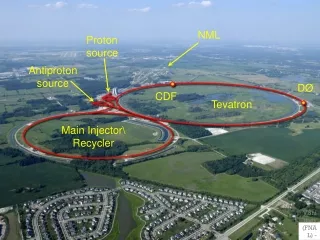
CDF (at B0) D0 High Rise Tevatron 8 GeV Booster Main Injector
Debuncher, accumulator rings 2 1 3 4 6 5
1. Cockroft-Walton, 750 keV 2. Linac, 400 MeV 3. Booster, 8 GeV (H- ions) (at end, H-p) 4. Main Injector, 150 GeV 5. Tevatron, 1 TeV 6. antiproton target (120 GeV) and Recycler (8 GeV)
Antiproton availability is the most important factor limiting luminosity. The Run II mode of operation: • Making many antiprotons (use 120GeV protons, capture them over broad momentum interval) • 5 1012 proton bunch makes 9 107 antiprotons around p=8 Gev. Captured with Li lens. Stored in Debuncher ring. Moved to Accumulator ring. • “Cooling” the antiprotons (in Debuncher ring): • “Stochastic”cooling (Nobel to Van Der Meer): RF pickup from proton beam signals frequenccy components outside central orbit. Amplified OPPOSITE signal is fed back to THE SAME protons on the opposite side of ring (diameter < ½ circumference) and reduces deviant freq. Components. • Electron cooling (invented in Novosibirsk): electrons are easier to cool than protons, because they irradiate. A very cold beam of electrons is “mixed” with proton beam by giving it same as protons; due to 2nd law of thermodynamics, proton beam cools. • Antiproton cycle: pre-storage:produced at 8 GeV from 120 GeV protons, debunched, cooled. Gradually stacked – for hours -into Accumulator ring . Accelerated in Main Injector. Then to Tevatron, for acceleration and luminosity. Post-storage:decelerate to 120 GeV, then to 8 Gev in Main Inj., store and cool in Recycler. Not done yet!
The upgraded CDFII detector (briefly) • Necessary to: handle higher rates, shorter interbunch (132 ns). • New Si detectors: - SVX II, Si microvertex det., 3 barrels, 5 layers - Interm. Si Layers (ISL), 2 layers at higher • New Central (Outer) drift Ch. (COT), with <130ns max. drift time AND online track processor (XFT, al LV1Trig., C.Sánchez) • Scint. Sampling calorimetry over whole range for faster response, good hermeticity. EM (21 r.l., includes pre-shower and shower max. detectors) and Had. Calo. (3.5 ), both with uniform pattern of segmentation in . • LV2 trigger processor SVT: a VERTEX trigger, high eff. On b, c displaced vertices. Trigger on b’s is very important physics enhancement.
Three results from CDF, Run I: • Jet ET inclusive spectra: new physics? • W mass measurement (transverse mass) • Discovery of the top quark (1994-1995)
Inclusive Central Jet Cross Section Data over ~7 orders of magnitude Run1a and 1b results consistent .. Observed deviation in tail …….. is this a sign of new physics ?
SM explanation (gluon at high-x) Important gluon-gluon and gluon-quark contributions at high- Gluon pdf at high-x not well known… …room for SM explanation….
CONCLUSION: • Obviously, need better knowledge of parton density functions (pdf). • tomorrow Mario will show you how to gain such knowledge. • An impressive spectrum, but no reason to get excited yet.
Measuring the W mass at hadron colliders • W production: udW (both quarks from sea at pp machines) • W decay: W e, and transverse massmethod • Invariant mass: M2=2E1E2(1-cos(p1p2)) • Cannot use it: only measure ET of neutrino... • Use MT instead: MT2= 2 ETe Etmiss (1-cos(12)) • In general, MT < M, but not for , where most of is! • Fun to prove this: consider simplified case of W e produced at rest, and decaying isotropically: then MT = MW sin and d/dMT = d/dcos · dcos/dMT = const · sin/cos , for which is why d/dMT peaks at MW (Jacobian peak)
W transverse mass distribution edge gives W mass .. and tail gives W width
The long search for top: 1977-94 (from Chris Quigg) open circles– indirect estimates from fit of EW observables solid line -e+e- colliders broken line - ppbar collisions dot-dashed line - from W width from ppbar -> ( W or Z) + nothing triangles - CDF direct measurements inverted triangles - DØ direct measurements crossed box - world average
Dilepton channel Two high PT leptons (e or m) PT>20 GeV, central (-1.1<h<1.1), oppositely charged at least one of the lepton must be isolated Mee or Mmm not in Z mass region (75-105 GeV/c2) Significant missing energy from two n’s Two or more jets with ET>10 and -2.0<h<2.0 b l- n l+ b n Dilepton Channel • Dominant Backgrounds: WW, Z tt, fake leptons, Drell-Yan • Features: good signal-to-background ratio low statistics not ideal for t mass reconstruction observed: 9 events (1ee, 1mm, 7em) total background: 2.4±0.5
Signature: one central and Isolated high PT lepton (e or m) missing ET from the n, (ET>20 GeV) 3 or more jets, ETjet > 15 GeV Dominant Backgrounds: Non W background (fake leptons) pp W + n×Jets Signal region is: S/B » 1/6 Reduce the background fraction by “b-tagging” top events always contain b jets, usually W+jets events do not b l- n q b q Lepton + Jets Selection • Secondary VerteX Tagging e(SVX) ~ 42% tag b-quarks using displaced vertex • Identify semileptonic B decaye(SoftLeptonTagging) ~ 20% • tag b-quarks using semileptonic decays
Top mass from lepton + jet sample • Split data into 4 exclusive subsamples with different S/B ratios SVX double tagged SVX single tagged SLT without SVX tags events non-tagged events (ET(jet4)>15 GeV)
All hadronic mass CDF preliminary • No n’s - all jets are measured. • At least one SECVTX (displaced vertex) tag (S/N~1/3). • Resolution: dominate the combinatorial effect. • Kinematic fit to individual events (3C fit). • Combination with lowest c2 is chosen • Experimental mass distribution is compared to HERWIG tt MC and to back- ground samples. b q q b q q
Top Mass Summary 161±20 GeV/c2 186±16GeV/c2 175.9±6.9 GeV/c2 CombinedMass
Luminosity: past and present • Run Ib (’94-’96): = 1.5 –2.5 E31, Lint = 89 pb-1 • Run IIa (’00-…) goal: 2 E32, Lint = 2 fb-1 …currently: 5 E31, Lint 200 pb-1 for Run II – and expect Lint(2003)= 225 pb-1 • Why so low?: Recycler Ring not used (x2 less L) too few antiprotons? (x2 less ) • L better improve, else physics reach will be modest • A separate – or related? - issue: Tevatron now operating with 36x36 bunches (396 ns interbunch), but it was expected to be capable of 108x108 bunches (132 ns interbunch): 396 ns interbunch, = 2 E32<Ncoll> = 3132 ns interbunch, = 1 E32 <Ncoll> = 2