Understanding Game AI: Collaborative Diffusion and Intelligent Agent Techniques
This overview explores the differences between traditional AI and Game AI, delving into concepts such as Collaborative Diffusion and single versus multi-agent systems. It emphasizes the significance of pathfinding algorithms, how artificial opponents adapt to player behaviors, and the ecological aspects of AI in gaming. Adaptive techniques, including flocking and problem-solving collaborations, are discussed, illustrating their applications in complex simulations. The computational needs are outlined, ensuring Game AI operates effectively at high frame rates while remaining simple to program.

Understanding Game AI: Collaborative Diffusion and Intelligent Agent Techniques
E N D
Presentation Transcript
artificial intelligencechapter 1: Game AI • Alexander Repenning
Objectives • learn about difference between AI and Game AI • learn about a new AI approach called Collaborate Diffusion
game AI • single Agent • ALife: agent acts intelligent: develops goals based on needs, pursues goals. • path finding (e.g., A*): • artificial opponents finds ways trough maze to get you • Sims: find refrigerator in house and food inside • learning: artificial opponents learn about your behavior making game play progressively harder • multi Agents • flocking, emergence • collaboration
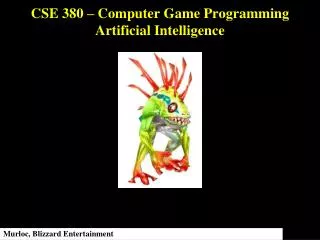
challenges • Computational: • AI needs to “run” at 60 frames per second • symbolic AI is (mostly) non-incremental • Psychological: • AI needs to “look” right • often very simple, e.g., random, e.g. Mt. Vetro’s eyes
more pointers: • good site: http://www.gameai.com/ • new book: AI for Game Developers, David M. Bourg
ideas • Diffusion Search: combine the notion of diffusion (a formal conceptualization on how things spread) with Search, e.g., hill climbing • Collaborate Diffusion: use Diffusion Search in a multi agent setting to express collaboration and competition
diffusion (physics) the process of diffusing; the intermingling of molecules in gases and liquids as a result of random thermal agitation www.cogsci.princeton.edu/cgi-bin/webwn the spread of social institutions (and myths and skills) from one society to another www.cogsci.princeton.edu/cgi-bin/webwn dissemination: the property of being diffused or dispersed www.cogsci.princeton.edu/cgi-bin/webwn dispersion: the act of dispersing or diffusing something; "the dispersion of the troops"; "the diffusion of knowledge" www.cogsci.princeton.edu/cgi-bin/webwn The movement of chemical species (ions or molecules ) under the influence of concentration difference. The species will move from the high concentration area to the low concentration area till the concentration is uniform in the whole phase. Diffusion in solutions is the most important phenomenon in electrochemistry, but diffusion will occur also in gases and solids. electrochem.cwru.edu/ed/dict.htm the movement of particles from an area of higher concentration to an area of lower concentration coris.noaa.gov/glossary/glossary_a_k.html
Collaborative Diffusion • well suited for complex, multi-agent simulation game: path finding, ALife, flocking, emergence and collaboration • new: developed at CU, started on Connection Machine • computationally expensive but at the same time incremental: works well on current computers and as part of game engines • traditional game AI (e.g., A* for pathfinding) approaches are not incremental
characteristics • Spatial Extend: works for agents with spatial relationships (2D, 3D, connection machine: 12D) • Simple to Program: algorithms are computationally expensive but relatively simple to built and tweak. • Ecological • traditional AI: AI in agent, e.g., robot • distributed AI: AI in agents⇒ flocking... • ecological AI: AI everywhere: agents & environment • Parallel: no chess-like turn taking • Incremental: AI state is part of environment and continuously updated • Robust: likely to work with situations not anticipated, e.g., soccer with n goals, m balls for n, m ≠ 2
diffusion equation u2 u1 u0 u3 • u0 = D (u1 + u2 +u3 +u4 - 4u0) + u0 • D: Diffusion coefficient [0..0.5] • simple: D = 0.25 => u0 = 0.25 *(u1 + u2 + u3 + u4) u4
4) Collaborative Problem Solving • multiple collaborative agents • collaborating: soccer, players from the same team • competing: soccer, players from the other team • changing goals: first track ball, then kick ball into goal • simple version: Collaboration trough Goal Obfuscation
sample projects • MySims: a version of the Sims • The Madness of Crowds: how people behave in panic