GASKAP: The Galactic ASKAP Survey for Exploring the Milky Way and Magellanic Clouds
140 likes | 266 Vues
GASKAP (Galactic ASKAP Survey) utilizes the Australian SKA Pathfinder with 36 antennas to study HI and OH emissions across the Galactic Plane and Magellanic Stream. Operating within 700-1800 MHz, this survey focuses on the evolution of galaxies and star formation phenomena. It aims to discover thousands of new masers and investigate evolved stars, magnetic fields, and kinematic structures within the Milky Way. Over five years, GASKAP will significantly enhance our understanding of galactic dynamics while mapping the universe's rich star formation history.


GASKAP: The Galactic ASKAP Survey for Exploring the Milky Way and Magellanic Clouds
E N D
Presentation Transcript
GASKAP The Galactic ASKAP Survey Dr Andrew Walsh On behalf of the GASKAP team
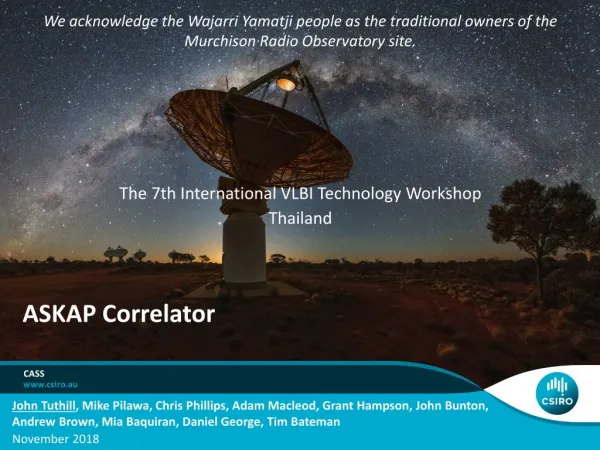
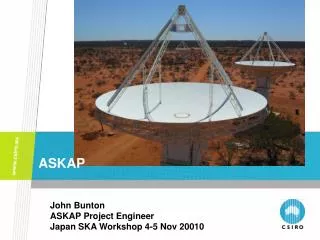
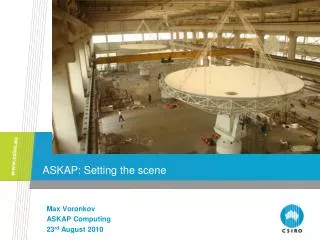
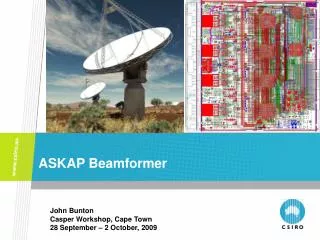
ASKAP – the Australian SKA Pathfinder • 36 x 12m antennas • Frequency range from 700 – 1800 MHz • 30 square degree field of view • Maximum baseline ~6km GASKAP
ASKAP – the Australian SKA Pathfinder • First 5 years, about 75% of time for Survey Science Projects (each at least 1500 hours) • Evolutionary Map of the Universe (EMU) • Widefield ASKAP L-Band Legacy All-Sky Blind Survey (WALLABY) • The First Large Absorption Survey in HI (FLASH) • An ASKAP Survey for Variables and Slow Transients (VAST) • Polarization Sky Survey of the Universe's Magnetism (POSSUM) • The Commensal Real-time ASKAP Fast Transients survey (CRAFT) • Deep Investigations of Neutral Gas Origins (DINGO) • The High Resolution Components of ASKAP (VLBI) • Compact Objects with ASKAP: Surveys and Timing (COAST) GASKAP –The Galactic ASKAP Survey GASKAP
GASKAP – The Galactic ASKAP Survey • HI emission at 1420 MHz • OH emission 1612, 1665 and 1667 MHz • Galactic Plane: |b|<10°, 167° < l < 360° and 0° < l < 79° • (all declinations south of δ=+40°) • Entire area of Magellanic Stream and Clouds • Sensitivity typically 1K at 30” resolution and 1 km/s GASKAP
GASKAP – The Galactic ASKAP Survey • HI emission at 1420 MHz • OH emission 1612, 1665 and 1667 MHz • Galactic Plane: |b|<10°, 167° < l < 360° and 0° < l < 79° • (all declinations south of δ=+40°) • Entire area of Magellanic Stream and Clouds • Sensitivity typically 1K at 30” resolution and 1 km/s GASKAP
GASKAP – The Galactic ASKAP Survey • HI emission at 1420 MHz • OH emission 1612, 1665 and 1667 MHz • Galactic Plane: |b|<10°, 167° < l < 360° and 0° < l < 79° • (all declinations south of δ=+40°) • Entire area of Magellanic Stream and Clouds • Sensitivity typically 1K at 30” resolution and 1 km/s GASKAP
Maser science with GASKAP • Evolved stars • Star formation • Galactic kinematics/structure • Magnetic fields • Variability • Milky Way – Magellanic Clouds comparison GASKAP
Maser science with GASKAP Evolved stars • Flux limited survey of evolved stars in the Milky Way • Expect to detect thousands of OH masers • Identify rare masers associated very young (<100yr) • planetary nebulae GASKAP
Maser science with GASKAP Star formation • Flux limited survey of star formation masers in the Milky Way • Expect to detect ~103 OH masers • Maser timelines • Star formation structure – disks/outflows Breen et al. (2010) maser timeline: H2O maser Class I CH3OH maser OH maser Class II CH3OH maser UCHII 104 3×10⁴ 4×10⁴ 5×10⁴ 0 2×10⁴ Time (years) GASKAP
(courtesy John Bally) Maser science with GASKAP Galactic Centre Structure (Artist’s impression byJohn Bally – private communication) Galactic Structure/Kinematics • Both evolved star and star formation masers used to trace structure and kinematics of the Milky Way and MCs • Star formation masers will be tightly linked to spiral arms – compare with Class II methanol masers from MMB • Structure of the Galactic Centre GASKAP
Maser science with GASKAP Magnetic Fields • OH, as paramagnetic molecule, is ideal polarisation tool • Demonstrates Zeeman splitting (large splitting factor, milliGauss fields) • Can be used to measure magnetic fields: • larger scale with star forming OH masers • small, local fields with evolved star masers • Sensitivity to probe polarisation of weak maser features GASKAP
Maser science with GASKAP Variability • OH masers are typically slowly varying over years • GASKAP will involve multi-epoch observations of bright masers over 5 years • Closely track variability in a large number of masers over these timescales GASKAP
Maser science with GASKAP Milky Way – Magellanic Clouds comparison • GASKAP MC observations will increase number of known masers by two orders of magnitude • Compare the occurrence of OH masers under normal- (Galactic) and low-metallicity (MCs) circumstances GASKAP
Summary • GASKAP will be coming in a few years • Observe the Galactic Plane, MCs and Magellanic Stream • Includes 1612, 1665 and 1667 MHz OH transitions • Discover thousands of new masers • Learn about: Evolved stars, Star formation, Galactic kinematics/structure, Magnetic fields, OH maser Variability, Milky Way – MCs comparison GASKAP