Download
1 / 6
60 likes | 232 Vues
This homework focuses on the basics of logarithmic functions as represented by their parent function and graph. We will explore key properties such as the domain and range, and emphasize the importance of understanding inverse relationships. Additionally, we will tackle a word problem related to population growth, calculating the time required for a town of 50,000 to double at a rate of 2.5% per year. Furthermore, we will learn how to graph logarithmic functions using changes of base formulas and geometric transformations.

E N D
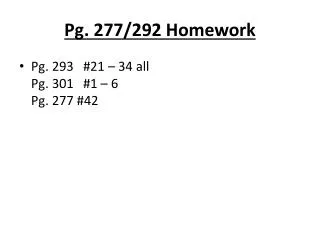
Pg. 277/292 Homework • Pg. 293 #21 – 34 allPg. 301 #1 – 6Pg. 277 #42
5.4 Logarithmic Functions and Their Properties • We will look at the basic equation ofbut, we are not going to discuss the intricacies of graphing, just the parent function and parent graph. • No matter the “b”, what does this graph look like? • What is the domain? • What is the range? • Why? • Think about inverses…
5.4 Logarithmic Functions and Their Properties Rewrite the following Logarithms Word Problem!! Use an algebraic method to find how long it would take a town with a population of 50,000, increasing continuously at the rate of 2.5% yearly, to reach a population of 100,000.
5.5 Graphs of Logarithmic Functions Graphing Logarithms Prove it! • In order to graph a logarithm in your calculator, you must use the change of base formula:
5.5 Graphs of Logarithmic Functions Transitions Graph the following Logarithms State the transitions and/or reflections that occur and the domain and range. • The graph of any logarithmic function of the form y = alogb(cx + d) + kcan be obtained by applying geometric transformations to the graph of y = logbx