Understanding Biogeochemical Cycling in Ecological Systems: A Fall 2006 Course Overview
120 likes | 239 Vues
This course (CIE 457/657, EFB 415/610) focuses on biogeochemical cycling in ecological systems, exploring fundamental principles and research methodologies. Taught by Professors C.T. Driscoll and M.J. Mitchell, classes are held on Mondays and Wednesdays from 12:45 PM to 2:15 PM. Evaluation includes proposals, midterms, presentations, and a final report. Key discussion topics involve carbon dynamics, nitrogen and phosphorus cycles, acidic deposition, and ecosystem health. Required texts include works by Schlesinger and Likens & Bormann, ensuring comprehensive learning.


Understanding Biogeochemical Cycling in Ecological Systems: A Fall 2006 Course Overview
E N D
Presentation Transcript
Biogeochemistry (Ecological)Fall 2006 CIE 457/657 EFB 415/610 Monday and Wednesday 12:45 pm to 2:15 pm Illick 16 Instructors: C.T. Driscoll and M.J. Mitchell
Objectives • To explain the principals of biogeochemical cycling in ecological systems. • To acquaint the student with the methodology needed to carry out research in biogeochemistry.
Books Required • W.H. Schlesinger (1997) Biogeochemistry: an Analysis of Global Change. Second Edition. Academic Press, San Diego, CA, 588 pp. • G.E. Likens and F.H. Bormann (1995) Biogeochemistry of a Forested Ecosystem. Second Edition. Springer-Verlag, NY, 159 pp.
Evaluation Proposal 5% Midterm 15% Class Discussion 15% Final Presentation 15% Final Written Report 25% Final 25%
Project • Analysis and interpretation of biogeochemical data (Not a term paper)
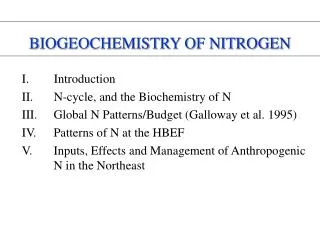
Discussion Topics • Not lecture but class discussion • Divide into groups • Carbon (global change) • Nitrogen • Phosphorus • Acidic Deposition • Cation Management and Ecosystem Health
The University's policy on academic dishonesty states: "The submission of any work by a student is taken as a guarantee that the thoughts and expressions in it are the student's own except when properly credited to another. Violations of this principle include giving or receiving aid in an exam or where otherwise prohibited, fraud, plagiarism, the falsification or forgery of any record, or any other deceptive act in connection with academic work. Plagiarism is the representation of another's words, ideas, programs, formulae, opinions, or other products of work as one's own, either overtly or by failing to attribute them to their true source" (Section 1.0, Syracuse University Academic Rules and Regulations). Plagiarism