Understanding SSS and SAS Criteria for Triangle Congruency
100 likes | 244 Vues
In this lesson, you will learn how to apply the SSS (Side-Side-Side) and SAS (Side-Angle-Side) criteria to determine triangle congruency. Activities include constructing congruent segments using given lengths and drawing scalene triangles while labeling their vertices. Gain hands-on experience in identifying congruence statements, such as ΔABC ≅ ΔRST, and understanding the role of included angles in these criteria. Through practical exercises, you'll build the skills to effectively analyze and verify triangle congruency using precise geometric principles.


Understanding SSS and SAS Criteria for Triangle Congruency
E N D
Presentation Transcript
SSS and SAS What You'll Learn You will learn to use the SSS and SAS tests for congruency.
B A C 2) Construct a segment congruent to AC. Label the endpoints of the segment D and E. 3) Construct a segment congruent to AB. 4) Construct a segment congruent to CB. F 6) Draw DF and EF. D E SSS and SAS 5) Label the intersection F. 1) Draw an acute scalene triangle on a piece of paper. Label its vertices A, B, and C, on the interior of each angle. This activity suggests the following postulate.
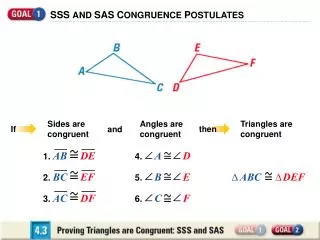
S B ST RS and RT and If AC T C R A BC AB SSS and SAS three sides corresponding then ΔABC ΔRST
In two triangles, ZY FE, XY DE, and XZ DF. X D Y E Z F SSS and SAS Write a congruence statement for the two triangles. Sample Answer: ΔZXY ΔFDE
C is the included angle of CA and CB C A B B is the included angle of BA and BC A is the included angle of AB and AC SSS and SAS In a triangle, the angle formed by two given sides is called the ____________ of the sides. included angle Using the SSS Postulate, you can show that two triangles are congruent if theircorresponding sides are congruent. You can also show their congruence by using two sides and the ____________. included angle
S B RS RT and If AC T C R A AB SSS and SAS included angle two sides A R and then ΔABC ΔRST
Q D R F E P D is not the included angle for DF and EF. SSS and SAS On a piece of paper, write your response to the following: Determine whether the triangles are congruent by SAS. • If so, write a statement of congruence and tell why they are congruent. • If not, explain your reasoning. NO!