Download
1 / 1
10 likes | 112 Vues
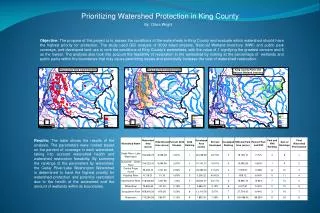
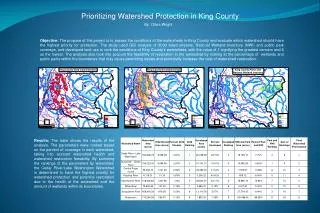
This project assesses the conditions of watersheds in King County, aiming to identify which should be prioritized for protection. Utilizing GIS analysis, the study evaluated 303(d) listed streams, National Wetland Inventory data, public park coverage, and developed land use to rank watershed health — with lower ranks indicating greater concern. Additionally, the analysis considered the feasibility of restoration, focusing on wetland and park percentages that may pose permitting challenges. The Cedar River/Lake Washington Watershed emerged as the highest priority for conservation and potential restoration efforts.

E N D
Prioritizing Watershed Protection in King County By: Olivia Wright Objective: The purpose of this project is to assess the conditions of the watersheds in King County and evaluate which watershed should have the highest priority for protection. The study used GIS analysis of 303d listed streams, National Wetland Inventory (NWI) and public park coverage, and developed land use to rank the conditions of King County’s watersheds, with the value of 1 signifying the greatest concern and 8 as the lowest. The analysis also took into account the feasibility of restoration in the watershed by looking at the percentage of wetlands and public parks within the boundaries that may cause permitting issues and potentially increase the cost of watershed restoration. Results: The table shows the results of the analysis. The parameters were ranked based on the percent of coverage in each watershed, taking into account watershed health and watershed restoration feasibility. By summing the rankings of the parameters by watershed, the Cedar River/Lake Washington Watershed is determined to have the highest priority for watershed protection and potential restoration due to the health of the watershed and the amount of wetlands within its boundaries.