Major Key Signatures
This guide offers a clear overview of major key signatures in music, detailing the order of sharps and flats. Discover the mnemonic devices used to remember these signatures: "Father Charles Goes Down And Eats Breakfast" for sharps, and the flat order for flats where the key name is found next to the last flat. Learn how the number of sharps and flats correlates to key signatures, with examples showcasing F major, F♯ major, and A major. A valuable resource for musicians seeking to grasp key signature fundamentals.

Major Key Signatures
E N D
Presentation Transcript
Order of Sharps and Flats Order of the Sharps: Father Charles Goes Down And Eats Breakfast ♯ ♯ ♯ ♯ ♯ ♯ ♯ F C G D A E B Order of the Flats: The reverse of the Sharps ♭ ♭ ♭ ♭ ♭ ♭ ♭ B E A D G C F
Flat Rule The name of the key is the next-to-the-last flat. Flat order: Example : The key with four flats is A♭ because A♭ is the third flat. ♭ ♭ ♭ ♭ ♭ ♭ ♭ B E A D G C F
Sharp Rule The name of the key is one half step higher than the last sharp. Sharp order: C♯ D♯ F♯ G♯ A♯ C♯ ♯ ♯ ♯ ♯ ♯ ♯ ♯ F C G D A E B Higher The key of A has three sharps because A is one half step higher than G♯.
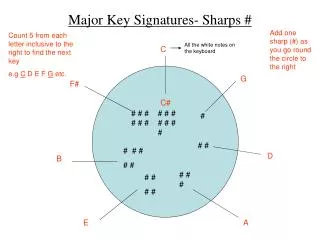
Major Key “Crutch” Sharps 7 6 5 4 3 2 1 0 ♯ ♯ C F C F B E A D G C G C ♭ ♭ ♭ ♭ ♭ ♭ B E A D 0 1 2 3 4 5 6 7 Flats
The Crutch (circle) Teaches . . . All the major key signatures: F major has one flat, F♯ major has six sharps, A major has three sharps, and so forth. The number of sharps plus flats of same letter keys always equals 7. Example: B♭ (2 flats) + B (5 sharps) = 7 C = no sharps or flats. C♯ = 7 sharps. C♭ = 7 flats. F♯ & G♭(same note) both have 6 (sharps & flats).