Transitioning from Implicit to Explicit, Public to Personal, Interaction with Multiple Users
150 likes | 286 Vues
This presentation explores the evolution of interactive public displays, focusing on transitioning from implicit to explicit information and public to personal interactions. We discuss the challenges in engaging users while maintaining privacy and minimizing sensory overload. Drawing from design principles and an interactive framework, we showcase a multi-phase system that incorporates ambient displays, gesture recognition, and touch-sensitivity. Our findings from user studies highlight the effectiveness and usability of this innovative approach, paving the way for real-time, sharable public displays that enhance personal information access.


Transitioning from Implicit to Explicit, Public to Personal, Interaction with Multiple Users
E N D
Presentation Transcript
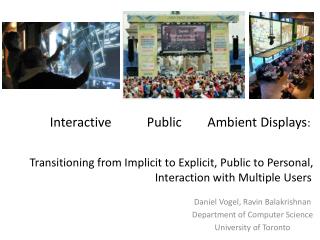
Transitioning from Implicit to Explicit, Public to Personal, Interaction with Multiple Users InteractivePublic Ambient Displays: Daniel Vogel, RavinBalakrishnan Department of Computer Science University of Toronto
Why do we need a interactive public display? • Information exchanging • A dream of ubiquitous computing • A gateway to access our personal information
How? Challenges • Public: attention • Not overloading users’ senses • Minimally intrusive • Personal: privacy • Sharing interaction
Bringing people from public to personal Streitz, et al., 2003 Vogel, et al., 2004
Design Principles and Interaction Framework • Goal: seamlessly, fluidly • implicit explicit • Public personal • Solve the dilemma of dual role • Solution: user’s attention (location and orientation) to the display and relationship between availableinformationtype and user’s phase
Hardware and layout 50” plasma screen with toch-sensitive overlay Vicon for tracking From top to bottom: weather, office activity, calendar, and messaging
Ambient Display Phase • able to get a sense of the overall information space with a quick glance • Calm aesthetics,shared use, comprehension and Immediate Usability • Tech: text labels
Implicit Interaction Phase • Calm aesthetics and notification • Tech: vertical bar • :appearance (location) • width (body orientation) • opacity (head orientation) Notification Flag
Subtle Interaction Phase I(Overview) • Distance < 40” • Why • Shared use and Immediate Usability
Informal User Study • four participants • work in an office environment, and were fluent with various computational media • Our evaluation had two parts. • First • Method: talk-aloud • how they explore their movements influenced the display and their interpretation • glove with markers for hand tracking was not used in the first part of the evaluation • Second • the gestures performance, gesture hint icons effectiveness, timeline navigation, and the phase of touch-screen initiation • did not implement help sequences
Summary • Fluid movement between phases • Techniques for multiple users • Subtle notification • Privacy controls • Self-revealing help • Implicit interaction was enabled by sensing contextual cues such as body orientation and position, and user proximity to the display. • Hand gestures and touch screen input support explicit interaction.
Conclusion • a new style of interactive public ambient display combining peripheral notification with implicit and explicit interaction for accessing both public and personal information • Initial user feedback indicates that our techniques are quickly discoverable and appear to be usable. • A set of design principles and an interaction framework that fluidly moves from implicit interaction with a public ambient peripheral display to explicit interaction • Taking us a step closer to realizing more sophisticated and useful sharable, interactive, public ambient displays.