Download
1 / 10
0 likes | 1 Vues
Discover Contemporary Dance as a powerful blend of ballet, modern, and jazz that encourages emotional expression and individuality. Contemporary Dance Classes build strength, creativity, and confidence through fluid movement, improvisation, and personal storytelling. Visit for more info: https://dancersgallery.com/contemporary-dance-classes

E N D
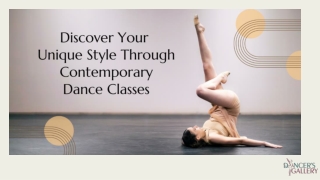
Contemporary Dance is a dynamic, emotion-pushed style that breaks unfastened from rigid classical techniques, mixing elements of ballet, modern day, jazz, and ethnicforms to create expressive motion. More than just choreography, it’s a philosophy that lets in dancers to talk their world through fluid, powerful motions. If you’re in search of a creative outlet that demanding situations each body and thoughts, Contemporary Dance Classes offer a journey of self-discovery where you may expand and express your own unique motion style.
Understanding the Elements of Contemporary Dance To unlock your unique style in a Contemporary Dance setting, it helps to understand the core elements that distinguish this genre. Unlike disciplines cantered strictlyon shape, contemporary dance emphasizes: • Release and Recovery:This involves the usage of gravity to initiate movement (release) and then gaining knowledge of the controlled attempt to regain stability (recovery). A key aim is making motion appear easy and fluid. • Contraction and Release:Pioneered by Martha Graham, the contraction is a shaping of the torso, often used to specific sturdy emotion, followed by a sudden or gradual release back to a neutral spine.
Spacial Awareness (Focus): Dancers learn to utilize the whole area—low (at the ground), middle (standing), and high (jumping/lifting). Your recognition (in which your appearance) is likewise a powerful device for storytelling and directing the audience's eye. • Weight Sharing and Partnering:Many Contemporary Dance Classes incorporate factors of secure, creative partnering, learning to share weight, lift, and help every other dancer—all of which require consider and conversation. • Floorwork: Using the floor as an active partner in the dance, concerning rolls, slides, and complex transitions from status to the floor and returned up. This grounds the dance and adds physical intensity.
How Instructors Guide Style Exploration in Contemporary Dance Classes The best Contemporary Dance Classes are led with the aid of instructors who understand that they may be guiding artists, not just teaching students. Their method is designed to foster individuality: • Encouraging Improvisation:This is possibly the most essential tool. Instead of rote learning, teachers dedicate good sized time to improvisational sporting events. They would possibly provide simple activates—"move like water," "explore a feeling of tension," or "tour from corner to corner without lifting your feet." By casting off the stress of a "right" step, the dancer is compelled to concentrate to their own body's instincts, revealing proper, un-choreographed movement patterns that end up the bedrock of their style.
Teaching Varied Choreographic Styles: A good contemporary curriculum will reveal you to specific modern techniques—from the athletic force of Hofesh Shechter to the pedestrian subtlety of Trisha Brown. By analyzing various approaches, you may obviously gravitate towards or integrate elements that resonate with your own body's natural inclination. • Focusing on Dynamics: Dynamics talk over with how a movement is completed (e.g., fast, gradual, sharp, smooth, weighted, light). Instructors will regularly ask college students to perform the identical word with noticeably extraordinary dynamics. This challenges the dancer to head beyond the mere form of the motion and focus on how they are transferring, leading to a extra nuanced and private overall performance. • Using Breath as an Initiator:The breath is inextricably related to emotion and motion. Teachers encourage using the exhale to deepen a floor stretch or the inhale to prepare for a powerful bounce. Learning to sync breath with motion creates an natural, flowing high-quality this is deeply expressive and completely personal.
Building Confidence Through Expressive Practice The ultimate barrier to coming across a unique style is frequently worry—the worry of looking "incorrect" or uncoordinated. Contemporary Dance Classes offer a unique, safe environment to overcome this. The expressiveness inherent in the genre naturally builds confidence: • Authenticity Over Perfection: In ballet, there is mostly a prescribed perfect line. In comparison, contemporary dance values authenticity. If your movement communicates the goal, it's far successful. This shifts the focal point from external judgment to inner reality, reducing the pressure and releasing you to take risks.
The Power of Vulnerability: Contemporary dance regularly calls for dancers to discover vulnerable or complex feelings—sadness, struggle, joy, or rage—without hiding them. Practicing this kind of emotional honesty in a supportive studio setting interprets without delay to personal confidence in all regions of life. You analyze that your feelings, your history, and your precise frame are your best artistic property. • Community Support: Dance studios that provide Contemporary Dance Classes frequently domesticate a supportive, non-competitive environment. Dancers are united by the not unusual intention of exploring movement and supporting each different innovative journeys. This environment allows you to experiment freely, understanding that your peers and trainer are there to uplift your manner.
As you spend time working through complicated choreographies, embodying raw emotion at some point of improvisation, and getting to know challenging floor transitions, you advantage a quiet, intrinsic self-assurance that comes from understanding your body is capable of sophisticated storytelling. This consciousness is the very last, vital element in solidifying your unique style. Contemporary Dance Classes are more than a weekly activity—they’re an investment in both physical strength and creative expression, combining technical precision with emotional freedom. If you’re ready to move beyond basic steps and exploredance as a powerful, personal form of communication, finding a quality local studio offering Contemporary Dance Classes is the perfect next step.
Contact Us 954-437-9910 info@dancersgallery.com


![[PDF] Free Download A Dance with Dragons By George R.R. Martin](https://cdn4.slideserve.com/8308900/slide1-dt.jpg)




![[PDF]❤️DOWNLOAD⚡️ The Many Sides Guide to Authentic Style: Create a style signature, express your true self through fash](https://cdn7.slideserve.com/12669890/slide1-dt.jpg)