Download
1 / 13
130 likes | 247 Vues
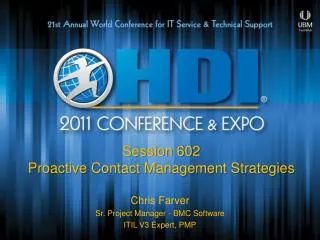
Join Chris Farver, Sr. Project Manager at BMC Software, for an insightful session on proactive contact management strategies in IT service desks. This session explores key concepts in transforming service desk operations from reactive to proactive by eliminating unnecessary contacts and automating essential processes. Discover ITIL best practices, and learn how to implement effective self-service solutions, enhance user education, and boost customer satisfaction while reducing costs per contact. Take home a practical action plan to optimize your service desk operations.

E N D
Session 602Proactive Contact Management Strategies Chris Farver Sr. Project Manager - BMC Software ITIL V3 Expert, PMP
Session Outline • Key Concepts • Solutions to Eliminate Contacts • Solutions to Automate Contacts • Cost Per Contact Type • Other Considerations • Benefits to the Service Desk • Take Home Action Plan
Key Concepts Focus Shift: “why are you being contacted VS what type of contacts are you getting” • Move from Reactive to Proactive • Self Help VS Self Service • Elimination VS Automation • Elimination Is Top Priority • Automate What Can’t Be Eliminated
Solutions to Eliminate Contacts • “80% of calls to the Service Desk are a result of change” • ITIL Best Practices • Problem Management – Root Cause Analysis • Change & Release Management • Proactive User Education & Communications • Implement Top 10 Callers Program • Use of Designated Callers • Broadcast Messages • Readily Available Knowledge Sources • FAQ (43.9%), KM (39.8%), Docs (31.8%)* *Data Source: 2010 HDI Best Practices Survey
Solutions to Automate Contacts Handling “Requests” for Service Web Based Service Catalog • Intranet/ Extranet based solution for on-line requesting of IT services • Start with list of services, forms to complete, methods of submitting • Invoke automated work flow engine as maturity grows (actionable) 2nd/3rd Level Groups On-Line Service Catalog PC IMAC Access Request Automation
Solutions to Automate Contacts • Automated Password Handling Solutions (32.0%*) • Self Ticket Submission (33.5*) & Self Ticket Status (40.2%*) • Auto Routing of Incidents • Based upon CTI and other parameters entered in Incident. • Front-end Messages • IVR – Speech Recognition • ACD - Skills Based Routing *Data Source: 2010 HDI Best Practices Survey
Cost per Contact Type $15 Chat* $50-75 $7 Self Help, $10 Self Service* Service Desk 2nd Level DSS Elimination Automation $20 Phone* 3rd Level - $75+ Mission Critical *Median Cost - Data Source: 2010 HDI Best Practices Survey
Other Considerations • Pre-document impact on call volume, Average Handle Time (AHT) and First Contact Resolution (FCR) • Educate users that Monday’s are busy, use alternate methods or wait if low priority • Proof of Concept - then patience on results • Persistence from Service Desk • Re-direct callers • Walk callers though automated process • Perform ROI follow-up, show cost/benefit of solutions over time
Benefits to the Service Desk • Service Desk Viewed as Proactive & Cost Aware • Service Desk Viewed as Lowest Cost Provider • Outsourcing Avoidance • Service Desk of more strategic value to IT ($) • Increased Customer Satisfaction • Efficient handling, improved AHT & FCR • Higher Retention at Service Desk • Improved Agent morale • Higher skill level at the Service Desk • Mundane tasks automated
Take Home Action Plan • Perform your contact management strategy analysis • Identify top candidates for elimination & automation • Look for quick wins and low hanging fruit to prove your case • Document current TCO and determine your cost per contact by type • Perform ROI analysis • Focus on Business Benefits – ITIL = IT to Business Alignment