Understanding Chronic Rhinitis: Types, Symptoms, and Treatment Options
Chronic rhinitis affects 10% of the population, manifesting as allergic, non-allergic, or mixed types. Allergic rhinitis impacts approximately 40 million Americans, leading to substantial economic costs and substantial quality of life issues. Symptoms include sneezing, itching, and nasal congestion, with severe cases potentially resulting in complications such as sinusitis and chronic otitis media. Diagnosis involves skin and serologic tests. Treatment options range from antihistamines to immunotherapy, emphasizing environmental control and the potential for new therapeutic approaches.

Understanding Chronic Rhinitis: Types, Symptoms, and Treatment Options
E N D
Presentation Transcript
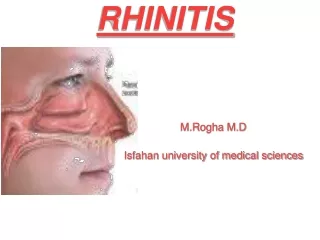
RHINITIS M.Rogha M.D Isfahan university of medical sciences
Chronic rhinitis • 10% of the population suffer from rhinitis • From those with rhinitis symptoms: 43% allergic rhinitis 23% non allergic type 34% mixed allergic & non allergic .
Chronic rhinitis can lead to: • sinusitis • nasal polyps • eustachian tube dysfunction • chronic otitis media • disorders of the sense of smell
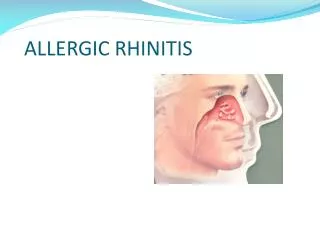
Allergic rhinitis • 40 million Americans may be affected by allergic rhinitis. • Economically, It costs about 2 billion dollars per year. • The patients suffer from its chronicity. • May accompany other aspects of allergy Asthma, urticaria, ….
Allergic rhinitis: Seasonal grasses, weeds, trees Perennial dust mite, molds, animal danders, cockroach
pathophysiology • Immediate type reaction • Specific IgE synthesis by B-lymphocytes • Sensitized mast cell formation • Bridging one molecule of Ag between two sIgE • Dissolution of mast cells& basophils • Release of inflammatory mediators
Pathophysiology contd. So, the main effects are: 1- vasodilation 2-increased permeability of vessels 3-irritation 4-gland stimulation
Symptoms & Signs • Itching • Sneezing • Rhinorrhea • Nasal congestion • Allergic salute • Allergic shiners • Dennie-morgan lines • Pale to bluish enlarged turbinates • others
Diagnosis • History & physical examination • Skin tests (in vivo) • Serologic tests (in vitro)
Skin tests • Epicutaneous scratch test prick puncture test • Intradermal single dilutional multi dilutional
Puncture/Prick Testing • Disease-free site • Swipe with alcohol • Apply drop of antigen (1:10 or 1:20 conc.) • Prick skin at 45 to 60 degree angle, or puncture at 90 degrees • Gently lift device, no bleeding should occur • Read positive control in 10 minutes • Read allergens in 15-20 minutes Example of a skin prick/puncture epicutaneous test
Multiple Antigen Testing cont’d Example of multiple-puncture device in its loading dock device allowing simultaneous placement of six allergens plus a positive and negative control 2 Example of multiple-puncture
Multiple Antigen Testing cont’d Example of positive and negative skin responses to allergens applied with a multiple-puncture device; note the positive and negative control sites Example of application of a multiple-puncture device to the forearm
Serologic tests • RAST (Radioallergosorbent test) Ag….sIgE….. Anti IgE* • ELISA (enzyme-linked immunosorbent assay)
treatment • Environmental control • Medical antihistamins;3 generation of them are available. corticosteroides; intopical & systemic forms diminish the effects of mediators by decreasing vascular permeability, stabilizing lysosomal membranes,…. alpha adrenergics mast cell stabilizers; chromolyn, olopatadine, quazolast,… leukotrien modifiers; zileuton, montelukast, zafirlukast. human recombinant anti IgE (Omalizumab) • immunotherapy
New directions in treatment: Tryptase inhibitors APC-366; pentamidine-like; BABIM-like; lactoferrin Cytokin modulators Pitrakinra Chemokin inhibitors Cell adhesion blockers neutralizing antibody to lL-5
Nonallergic Rhinitis (Vasomotor Rhinitis)
Non allergic rhinitis components: Nasal innervation vasculature Mucosal glands
pathophysiology • Anatomic effect • Autonomic nervous system effect
pathophysiology • Parasympathetic stimulation increased serous glands activity of nasal mucosa Rhinorrhea. • Direct sensory C-fibers stimulation, by histamin, bradykinin & inhaled irritants release of neuropeptides increased vascular permeability& glandular, endothelial & epithelial cell stimulation itching, rhinorrhea, burning sensation. • Hyper responsiveness of afferent sensory nerves exaggerated efferent response over secretion of mucus & increased nasal congestion. • Normal afferent input but hyper reactive efferent arc due to CNS impairment.
Diagnostic tests • Methacolin provocative test to evaluate glandular responsiveness. Positive in both allergic & nonallergic rhinitis • Histamin provocative test to evaluate vascular permeability. Positive in both types of rhinitis; mainly in allergic type. • Cold dry air increases mucosal osmolarity C-fiber stimulation, ….. Selective for non allergic rhinitis. • Capsaicin provocative test to evaluate sensory innervation (specific C-fiber stimulant). Selective for non allergic rhinitis.
Nonallergic Rhinitis classification • Infectious • Drug-induced • Hormonal • Anatomical • Idiopathic
Types of non allergic rhinitis • Drug induced rhinitis • Anti hypertensives • birth control pills • cocaine • nasal drop abuse • NSAID • antipsychotics
Causes of vasomotor rhinitis • Pregnancy & premenstrual cold • hypothyroidism • emotional causes • temperature mediated • irritative & environmental rhinitis • gustatory rhinitis • recumbency rhinitis • non airflow rhinitis • compensatory hypertrophic rhinitis • eosinophilic nonallergic rhinitis • Idiopathic rhinitis
Treatment of vasomotor rhinitis • Medical avoidance of irritative factors exercises topical nasal steroids decongestants anticholinergic medications (Ipratropium bromide) topical silver nitrate 5-20% • surgical endonasal surgeries vidian neurectomy