Cost-Efficient National Guard Aviation Proposal: Saving Over $1 Billion Annually
20 likes | 148 Vues
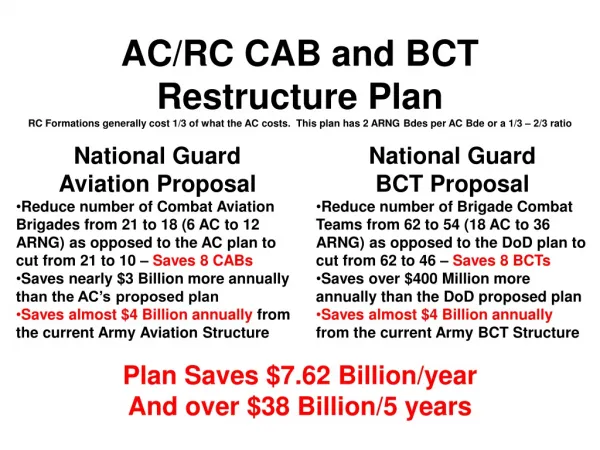
The National Guard Aviation Proposal aims to modify the current Active Duty Army aviation structure by transitioning from 11 National Guard Aviation Brigades (AB) to 10 Combat Aviation Brigades (CAB). This change is projected to save $100 million annually and over $1 billion in the first year. By reducing the number of brigades, significant savings are realized through lower operational costs, with National Guard aviation costing approximately $32 million per brigade compared to $77 million for Active Duty brigades. This proposal highlights a sustainable and cost-effective future for aviation resources.


Cost-Efficient National Guard Aviation Proposal: Saving Over $1 Billion Annually
E N D
Presentation Transcript
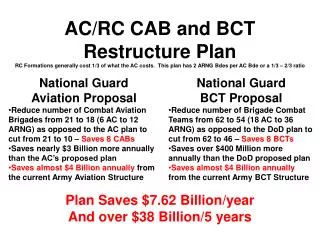
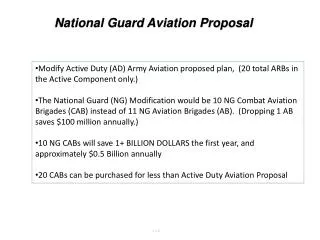
National Guard Aviation Proposal • Modify Active Duty (AD) Army Aviation proposed plan, (20 total ARBs in the Active Component only.) • The National Guard (NG) Modification would be 10 NG Combat Aviation Brigades (CAB) instead of 11 NG Aviation Brigades (AB). (Dropping 1 AB saves $100 million annually.) • 10 NG CABs will save 1+ BILLION DOLLARS the first year, and approximately $0.5 Billion annually • 20 CABs can be purchased for less than Active Duty Aviation Proposal V 1.0
National Guard Aviation Proposal How Cost Savings are Realized: AD ARB has an annual cost of $77 Million. NG ARB has an annual cost of $32 Million. NG saves $45 Million per ARB. National Guard ECAB costs $120-130 million. Subtract ARB cost (32 Million) from ECAB to get cost of NG AB. Actual Cost of NG AB ≈ $90 - $100 million AD Proposal (No NG ARBs) Costs 10 AD CABs with 20 ARB/ARSs ≈$ 4.51 billion 13 NG BDEs (10 ABs, 2 TABs, and 1 S&S BDE) = $0.88 billion AD Proposal Total Cost: $5.39 billion NG Proposal Costs: 10 AD CABs with 10 ARBs = $ 3.74 billion 10 NG CABs with 10 ARBs = $ 1.19 billion NG Proposal Total Cost: = $ 4.93billion Current Active Duty Proposal = $5.39 B (less) National Guard Proposal = $4.93 B Net Annual Savings $460 million Additional One-Time Cost Savings: Re-Training Costs of NG Aviation $1 million per Aviator X (8 ARB X MTOE ≈ 500 Aviators) = $500 million NG Proposal Saves $1 Billion for the first year, and thereafter approximately $0.5 Billion annually. V 1.0