Understanding Scientist Participation in Public Engagement Activities
30 likes | 177 Vues
This document explores the willingness and aptitude of scientists to engage in public outreach, highlighting key models of participation. Figures depict the development journeys of full-time science communicators versus those with science communication as a sideline. It emphasizes the need for structured support and planning to enhance expertise in public engagement over time. Adapted from key reports, this work serves as a framework for fostering effective public engagement among scientists, providing insights for institutions seeking to enrich their outreach efforts.


Understanding Scientist Participation in Public Engagement Activities
E N D
Presentation Transcript
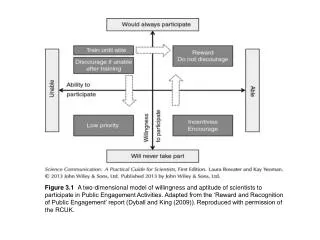
Figure 3.1 A two-dimensional model of willingness and aptitude of scientists to participate in Public Engagement Activities. Adapted from the ‘Reward and Recognition of Public Engagement’ report (Dyball and King (2009)). Reproduced with permission of the RCUK.
Figure 3.3 The graph represents the lifetime development of a full-time sciencecommunicator. The inset box shows the much smaller amount of time and developmentthat may apply to science communication when practiced (and taught as a sideline) to themain career of a scientist with initial training. However, with support and planningthroughout your career, further progress towards ‘expert’ can be achieved. Adapted from‘Towards a professional framework for scientists involved in public engagement work’, areport prepared for the Wellcome Sanger Institute by A. Macleod (2010). Reproduced bypermission of the Wellcome Trust Sanger Institute.