Download
1 / 12
120 likes | 270 Vues
This text explores how to describe relationships among variables using various mathematical formulas, including direct and inverse proportionality. We derive values using given conditions, such as finding the value of y when it’s directly proportional to x, and calculate y when it’s inversely proportional. Additionally, we discuss joint and varying proportionality in variables, with examples calculating the values of z based on multiple conditions. Each computation requires rounding the answer to the nearest hundredth, emphasizing the practical application of these concepts in problem-solving.

E N D
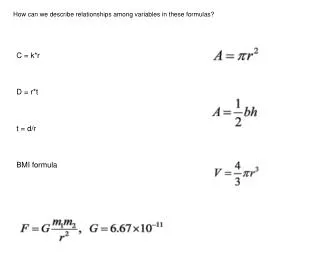
How can we describe relationships among variables in these formulas? C = k*r D = r*t t = d/r BMI formula
If y is directly proportional to x, and y = -61 when x = 27, find y if x = 13. (Round off your answer to the nearest hundredth.)
If y is inversely proportional to x, and y = -68 when x = 20, find y if x = 22. (Round off your answer to the nearest hundredth.)
Seat (Group) Work: 1.z is jointly proportional to x2 and y3. If z = 123 when x = 3, find z when x = 7 and y = 7. (Round off your answer to the nearest hundredth.) 2.z varies directly as the square root of x and inversely as the square of y. If z = 247 when x = 49 and y = 3, find z if x = 9 and y = 4. (Round off your answer to the nearest hundredth.)