Application of Satellite Observations for Ozone Attainment Planning in Texas (2011-2012)
10 likes | 145 Vues
This report outlines key activities and achievements in applying satellite data to ozone attainment planning in Texas from June 2011 to February 2012. Upcoming tasks include completing pseudo-data testing, integrating lightning NO emissions, and conducting Kalman Filter inversions for specified modeling episodes. Assessments will focus on how satellite-adjusted photolysis fields and NOx inventories affect ozone concentrations. Recent accomplishments include acquiring new OMI NO2 data and conducting a sensitivity analysis using satellite data. A manuscript is in preparation, and we will present findings at the upcoming American Geophysical Union meeting.


Application of Satellite Observations for Ozone Attainment Planning in Texas (2011-2012)
E N D
Presentation Transcript
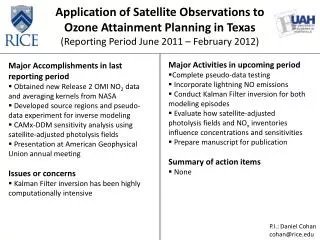
Application of Satellite Observations toOzone Attainment Planning in Texas(Reporting Period June 2011 – February 2012) • Major Activities in upcoming period • Complete pseudo-data testing • Incorporate lightning NO emissions • Conduct Kalman Filter inversion for both modeling episodes • Evaluate how satellite-adjusted photolysis fields and NOx inventories influence concentrations and sensitivities • Prepare manuscript for publication • Summary of action items • None • Major Accomplishments in last reporting period • Obtained new Release 2 OMI NO2 data and averaging kernels from NASA • Developed source regions and pseudo-data experiment for inverse modeling • CAMx-DDM sensitivity analysis using satellite-adjusted photolysis fields • Presentation at American Geophysical Union annual meeting • Issues or concerns • Kalman Filter inversion has been highly computationally intensive P.I.: Daniel Cohan cohan@rice.edu















![[PDF READ ONLINE] P.I. Butterfly: Birthday Bandit (P.I. Butterfly, 2)](https://cdn7.slideserve.com/12527188/slide1-dt.jpg)